








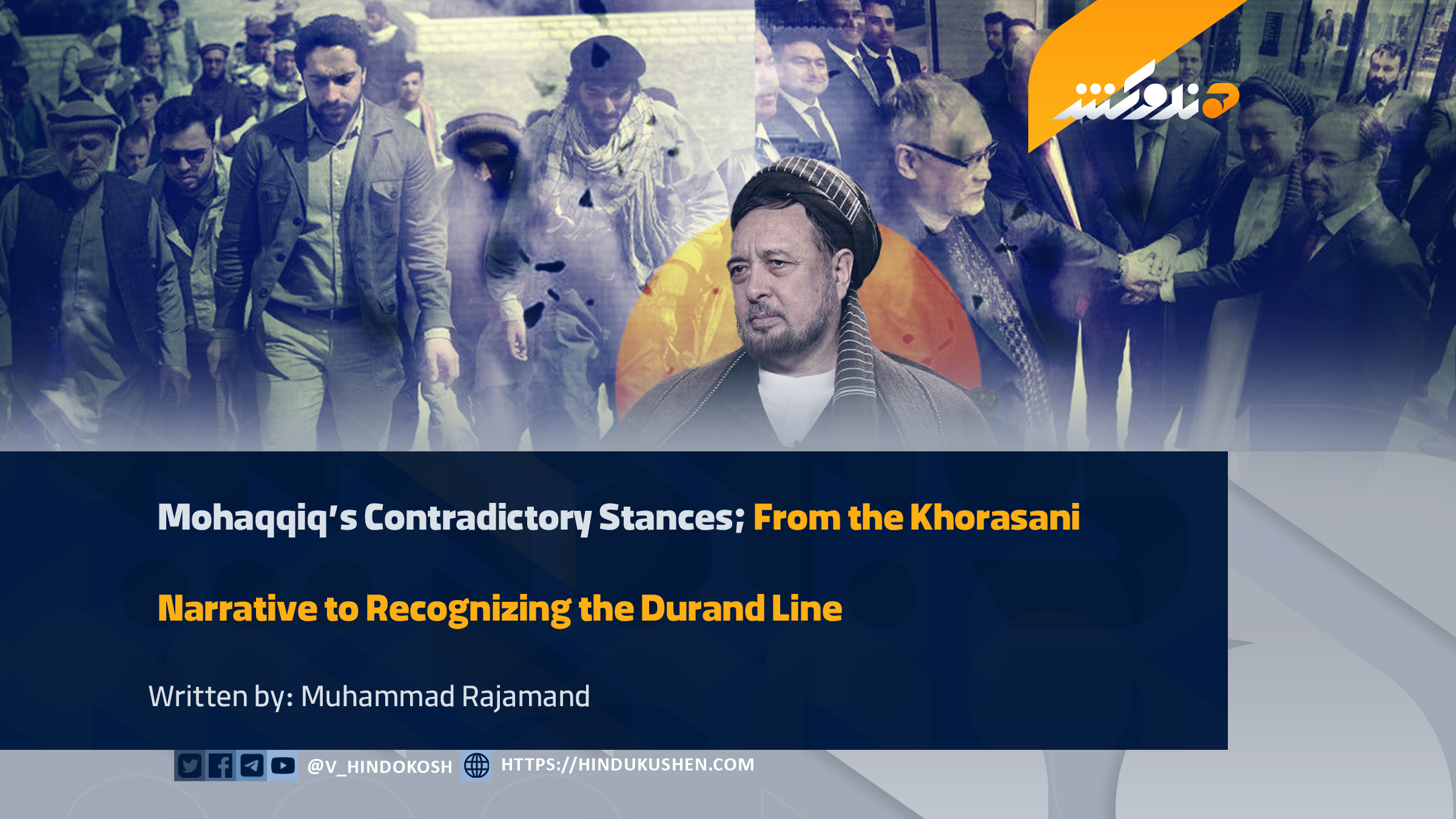
Written by: Muhammad Rajamand
In the political landscape of Afghanistan, some figures who have left the country following recent developments are trying to keep themselves alive in public opinion with new and sometimes differing statements. In this context, Mohammad Mohaqqiq’s recent statements have attracted more attention than others.
In his recent statements, Mohaqqiq has brought together several contradictory topics. On one hand, he emphasizes the independence(!) of Afghanistan, the role of the people’s will, and even the possibility of armed action against the Islamic government of Afghanistan; but on the other hand, by accepting the Durand Line as the official border, he enters one of the most sensitive historical debates of the country.
In his recent interview, he speaks of “pride in being from Khorasan and Hazaristan” and simultaneously claims that “the government of Afghanistan is in decline, but what remains is the will of the people.”
At first glance, it is not easy to reconcile these viewpoints. Emphasizing identities such as “Khorasani” or “Hazaristani” alongside discussions of national independence and acceptance of existing borders indicates a kind of intellectual inconsistency; because each of these concepts carries its own political and historical weight and usually requires a clear and coherent framework.
On the other hand, if we look at the opponents movements against the Afghan government, the problem is not limited to Mohaqqiq. Many of these groups, whether the Resistance Front or other political and imaginary councils, have fundamental disagreements with each other. The issue of the Durand Line is a clear example of these differences; some reject it, some accept it, and some do not have a clear stance.
This situation raises an important question: What is the purpose of presenting such contradictory positions?
It seems that these statements are made not with consideration of the realities on the ground in Afghanistan, but rather as an effort to remain in the political and media spotlight; especially at a time when the Islamic government of Afghanistan enjoys significant popularity among the people of the country, and these groups lack any popular support, with their words and actions contradicting the decisions, will, and interests of the people.
Therefore, overall, what emerges from these contradictory positions is indicative of a kind of intellectual confusion and the absence of a clear strategy among these opposing figures. The simultaneous promotion of concepts such as independence, armed struggle, acceptance of the Durand Line, and emphasis on Khorasani and Hazara identities is nothing but a reflection of the effort to maintain a presence in the media and prevent being forgotten.
On the other hand, the deep divisions among the opposing factions and their inability to reach a minimum agreement on major national issues indicate that these groups currently have no capacity to influence the political future of Afghanistan. In such circumstances, any claims about the change or collapse of the system are more rhetorical and propagandistic than based on objective realities.
Therefore, it can be said that as long as these factions cannot distance themselves from contradictions, align their views based on a clear definition of the interests of the Afghan people, and refrain from bargaining over major issues, they will not only lack a bright future for themselves but also will not play a decisive role in the future equations of Afghanistan.
Note: The articles, essays, and comments published by the Voice of Hindukush only reflect the views of the authors & writers and do not necessarily represent the agreement of the Voice of Hindukush.


