








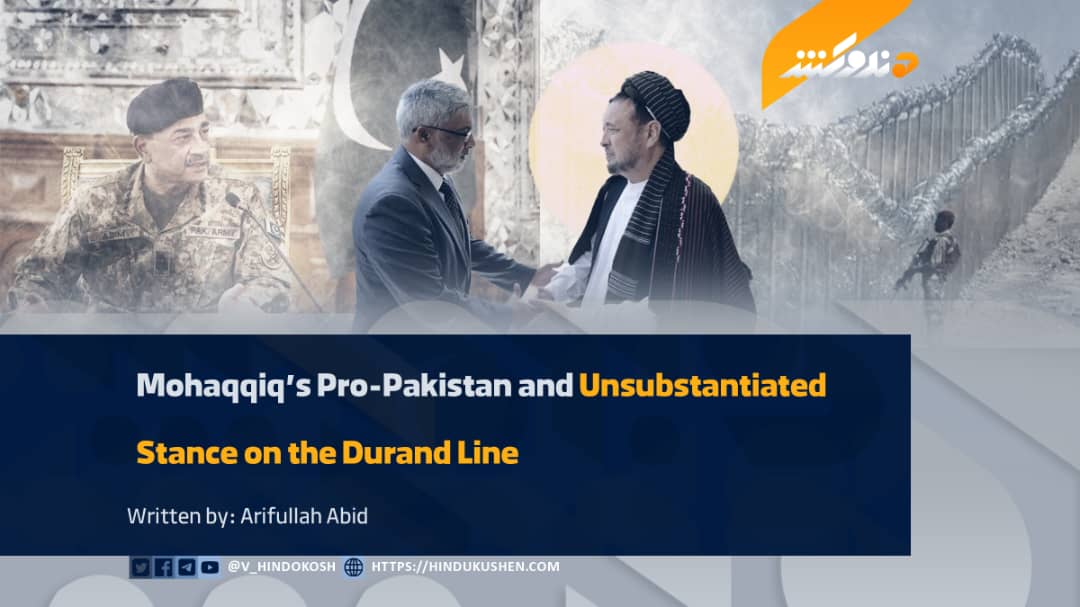
Written by: Arifullah Abid
In the contemporary history of Afghanistan, national identity and territorial integrity have always remained red lines, and any negotiation over them has faced a strong reaction from the nation. The recent statements by Mohammad Mohaqiq, the leader of the so-called Wahdat Party and a member of the imaginary Resistance Council, who accepted the Durand Line as an official border, represent a dangerous deviation from the country’s national interests and a clear betrayal of historical facts. This stance, based on political flattery rather than logical arguments, sends concerning messages about Pakistan’s influence among the opponents of the Afghan government.
Mohaqqiq has said that Afghans should overlook their historical grievances in light of Pakistan’s power. These statements are in conflict with international legal standards. In contemporary diplomacy, the borders or boundaries between countries are defined not based on the level of power, but on historical documents, legal treaties, and the will of nations. Accepting power and force in determining borders is, in fact, legitimizing the law of the jungle, under which any strong country could occupy the territory of a weaker neighbor. Such a stance of submission also means that a so-called political activist is losing their independent position.
From a legal perspective, the decision about the fate of a territory belongs to those who are connected to its identity and ownership. There is a serious contradiction here; the political circle to which Mohaqqiq himself belongs has denied the national identity of “Afghan” for years and has made the slogan “I am not Afghan” the cornerstone of its policy. How can they have the right to decide on the land and borders of the Afghans? According to the principle of ownership, those who deny an identity do not have the moral and legal authority to discuss the geographical boundaries of that very identity.
The praise of the Pakistani army chief by opponents like Mohaqqiq and the subsequent recognition of the Durand Line appear to be a clear political deal and flattery. Mohaqqiq has adopted a pro-Pakistan stance on the country’s sensitive issues to break his political isolation and attract the attention of regional powers. Such statements from the opposition are made to achieve Pakistan’s intelligence and military objectives.
The issue of the Durand Line is a historical, legal, and national claim whose resolution lies solely in the grand consensus and collective decision of the Afghan people. No individual, group, or party has the right to negotiate the fate of the entire nation for their short-term political goals or to prove loyalty to foreign powers. Mohaqqiq’s recent statements showed the extent to which the opponents harbor hatred toward Afghanistan and, to nurture this hatred, align themselves with Afghanistan’s enemies.
Mohammad Mohaqqiq’s irresponsible stances do not reflect the will of the Afghan nation and hold no weight in the scales of history. The responsibility of preserving Afghanistan’s territorial integrity lies with those who truly consider themselves the heirs of this land. Those who trade their homeland to please foreign generals must understand that their political flattery will never change the historical reality of Durand and will only tarnish their own political record further.
Note: The articles, essays, and comments published by the Voice of Hindukush only reflect the views of the authors & writers and do not necessarily represent the agreement of the Voice of Hindukush.


