








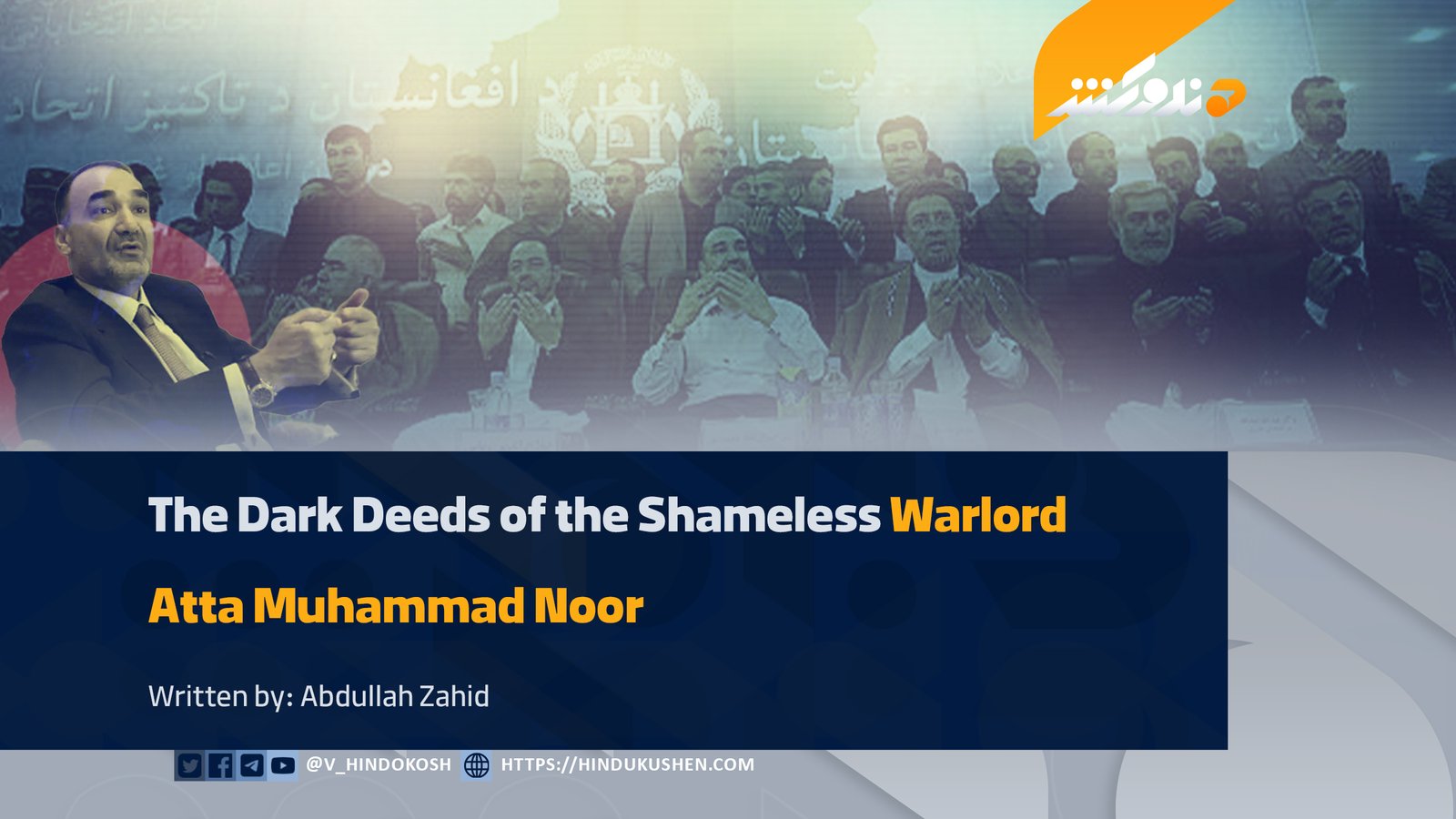
Written by: Abdullah Zahid
The bitterest truth of warlordism in Afghanistan is that dark figures, after creating a history of blood and terror, are honored with titles of heroism by a few other traitors. But history and the people’s memory do not forget; that fear, oppression, abduction, extortion, personal prisons, prejudice, and the devaluation of human life, which were inseparable from the culture of tyranny.
Today, when Atta Muhammad Noor openly says that he is not ashamed of being a warlord and takes pride in it, this is not an individual stance, but rather a defense of an era; the defense of an era for which the Afghan people paid the price with blood and millions of sacrifices. If warlordism is a pride, then this pride has brought graves, the disabled, refugees, and destruction as its legacy.
The leaders of the internal wars killed and injured thousands of civilians in Kabul to gain power, displaced tens of thousands of families from their homes, and turned a large part of Kabul into ruins. This was not a war against foreign invasion; it was a war for power and influence among these armed groups, of which Ata Muhammad Noor was considered one of the leaders.
The victims of the internal wars were those ordinary Afghans who paid the price of the warlords’ power with their blood, displacement, and destroyed homes. In just two weeks, eighteen hundred people were killed and one hundred twenty thousand were displaced from their homes. After that jihadist victory, which was bought with the blood of millions of Afghans.
Blind rocket attacks on civilian homes, mass killings in the city’s streets, torture, abductions, discrimination, and widespread looting were not the work of a single group, but rather a shared legacy of the factions that played for power in Kabul. All of this has happened at the behest of these warlords, which is why they took no steps to prevent it.
In October 2003, two years after the invaders arrived and before another war had begun, a battle broke out around Mazar-i-Sharif between these same warlords using tanks and artillery, resulting in the deaths of sixty people. This war was neither against the occupiers nor for the protection of national interests; rather, it was for the revenue of a province and the control of roads.
After this, the rule of Balkh came for fourteen years, and this was the phase in which warlordism became slightly more modern and transitioned to administrative positions. He placed his armed men in various organizations, and for a time, nearly eighty percent of the local police in Balkh were also affiliated with this one man. His family and close associates were appointed to key positions. He amassed great wealth from the networks of trade, land, ports, and drugs. Noor was not brought to the state to be subject to the law, but rather to prevent the state from being fragmented from the outside and to fully cooperate with the invaders; in other words, the invaders and the puppet regime, out of fear, handed over a province to Atta Noor as property.
When his power and influence were threatened, his true stance became clear; he did not accept the dismissal order and said, “I am still the governor.” When the puppet regime of that time appointed a new police chief for Balkh, Atta Noor ordered people to close their shops in response to this decision. Later, Noor was sidelined at a very high price because he gained many things that he didn’t have before.
This modern form of warlordism is what Atta Muhammad Noor still dreams of. History will eventually write all of this; today, if he deceive himself with any name, tomorrow history will judge him, and future generations will remember him as a traitor, a destroyer, and an opponent of all values.
Note: The articles, essays, and comments published by the Voice of Hindukush only reflect the views of the authors & writers and do not necessarily represent the agreement of the Voice of Hindukush.


