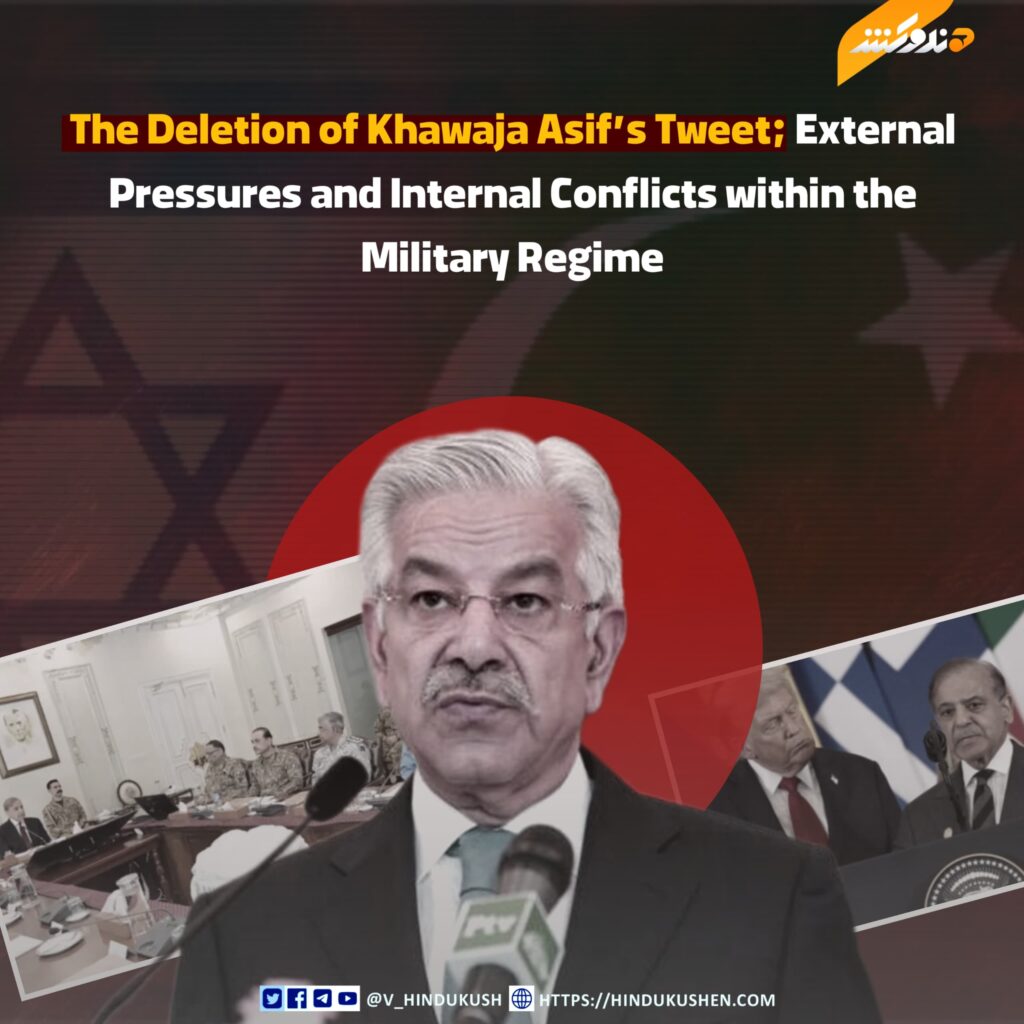





The posting of a harsh message against Israel by Pakistan’s Defense Minister Khawaja Asif on X, followed by its immediate deletion after a reaction from Israeli officials, was another clear example of the chaos and lack of an independent stance in Pakistan’s foreign policy. In the deleted tweet, Asif had called Israel an evil and a curse for humanity, but the lifespan of this tweet was very short; the waves of external diplomatic pressures and internal disagreements quickly retracted Pakistan’s harsh stance.
The deletion of this message actually demonstrates the weakness of Islamabad’s military regime in the face of international pressures. Although Asif’s statements seemed realistic in light of the regional realities and public sentiments, his retreat in response to Israel’s reaction proved that Pakistani officials lack the ability to withstand the consequences of their harsh remarks. This has raised serious questions about the complete lack of sovereignty and independence of the military regime and shows that its decisions are influenced by maintaining foreign credibility rather than national values.
Just minutes after Asif’s provocative tweet, the regime’s Prime Minister Shehbaz Sharif sent a message about a ceasefire and diplomatic efforts, clearly revealing the lack of coordination and deep divergence of opinions within Pakistan’s state apparatus. It seems that Shahbaz Sharif wanted to immediately neutralize the negative impact of Asif’s harsh statements and convey to the international community that Pakistan’s official policy differs from this stance. These and similar contradictions lead to Pakistan being recognized as a two-faced player on the international stage and expose the internal conflicts within its governmental apparatus.
The strong reactions from Israel’s Foreign Minister and other senior officials to Asif’s tweet, which labeled Pakistan as a problem rather than a peace mediator, have subjected Islamabad to severe diplomatic backlash and criticism. Israel skillfully exploited Asif’s remarks to question Pakistan’s efforts to play a mediating role between Iran and the United States. This issue has become a challenge for Pakistan in these critical days due to extensive coverage, as the initial hopes of Israel’s destruction followed by a retreat due to external and internal pressure have completely undermined the diplomatic weight of the military regime.
The Pakistani military regime and the government behind it are in a situation where, on one hand, they must show an anti-Israel stance due to internal religious and public pressure, but on the other hand, they are afraid of economic collapse and international isolation, so they cannot completely sever ties with Israel and its supporters. Deleting the tweet actually reveals the fear that Pakistan has about losing its diplomatic and financial interests. This dual policy has caused Pakistan to neither play a decisive leadership role in the Islamic world nor remain a trustworthy partner in the West.
It is worth mentioning that such slogans from Pakistan are often just to deceive public opinion; because Pakistan had shown readiness to send Pakistani troops to Gaza to disarm Palestinian fighters upon joining Trump’s peace board, to please the United States and Israel. The main objective behind this deal was for the United States to make extensive investments in mining in Balochistan and to help reduce its debts. The contradiction in the military regime’s positions shows that this regime is prepared to make secret deals with major powers on sensitive issues of the Ummah, such as Palestine, contrary to its slogans, for its material gains and survival.