








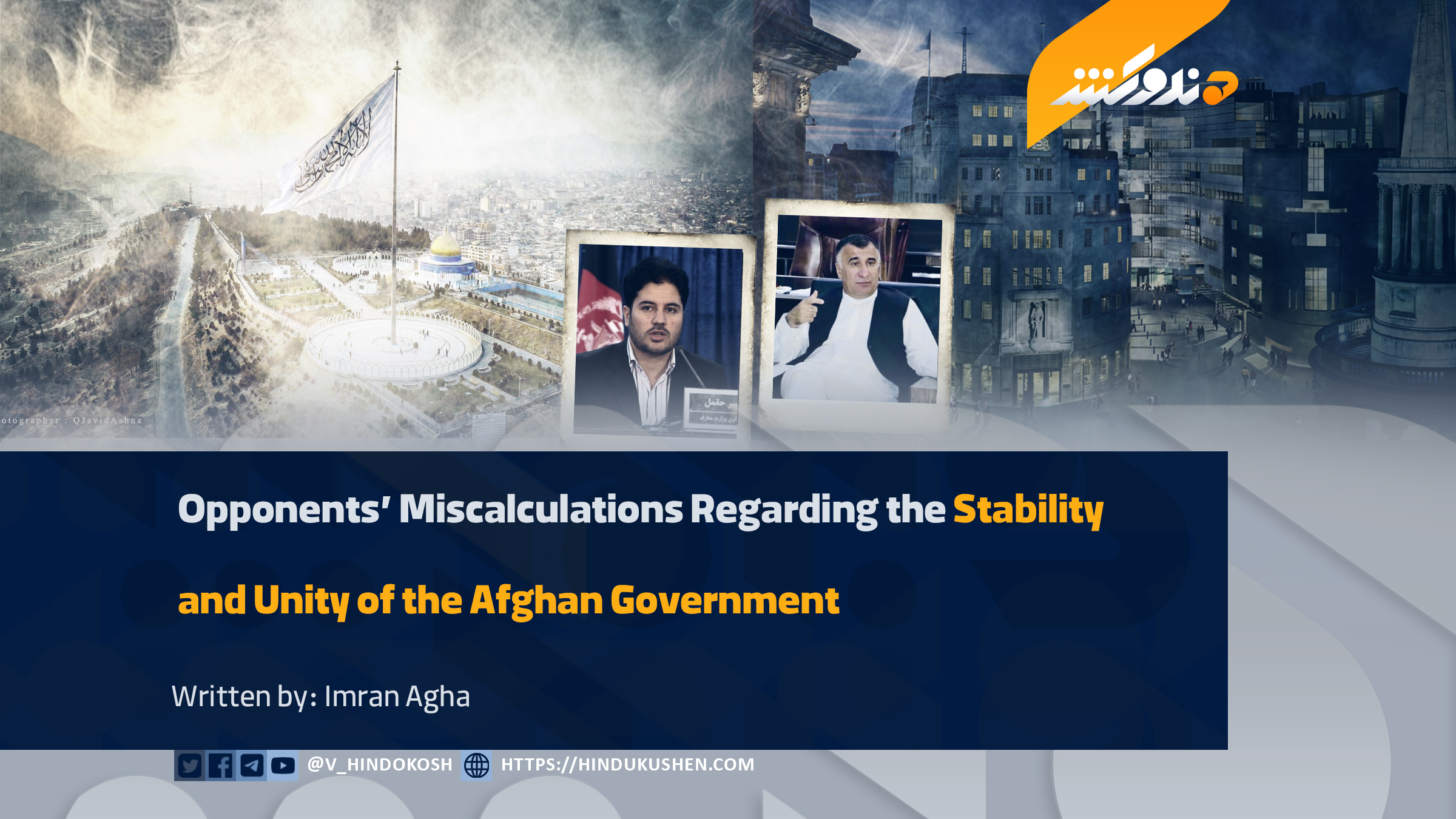
Written by: Imran Agha
The foundation of the continuity and stability of any system or government rests on internal unity. Since its establishment, the Islamic Emirate has practically demonstrated that it possesses a single decision-making authority, organized structures, full obedience, and a shared ideological objective. It is precisely this unity that, despite external pressure, propaganda warfare, and economic sanctions, has continued to steer the Afghan government toward greater strength. From the outset, the Islamic Emirate has been a system based on ideological unity, legitimate religious authority, and unified leadership.
Baseless reports about alleged disagreements within the leadership of the Afghan government are a clear part of media warfare and have no grounding in reality. Had genuine disagreements existed, they would certainly have manifested themselves in major decisions, changes of ministers, the provision of security, and other critical matters.
Reports by the BBC and other similarly biased media outlets, upon which some opponents of the Afghan government have pinned their false hopes, are based not on facts or sound political analysis, but on unknown sources and imaginary assumptions.
Biased platforms seek to present a fabricated image of internal divisions within the Afghan government to society and the world, an image that has no factual basis. Through such reports, political opponents of the Afghan government attempt to exploit the situation for their own political benefit, at the very least to remain visible in the media.
Even two officials of the former collapsed republic, Halim Fidai and Kabir Haqmal, have reacted to reports by biased media regarding alleged disagreements. They consider claims of discord among the leaders of the Afghan government to be a misinterpretation. They have openly stated that such reports against the Afghan government are not only unfounded, but in fact further consolidate and strengthen its ranks.
It is evident to all that artificial and baseless systems collapse at the first waves of internal disagreement. In contrast, the Afghan government has not only remained in place, but its administrative structure, security control, and centralized authority have grown stronger with each passing day.
On the other hand, the opponents of the Afghan government are themselves confronted with deep and fundamental divisions. Over the past four years, these opponents have failed to unite around a common vision, a shared political objective, or even a single unified stance. This failure is not accidental; rather, it is the clear result of conflicting interests and profound ideological differences among them. Even at critical moments, so-called conscious opponents have been unable to gather around a single table.
Despite facing inherited crises, international sanctions, and propaganda warfare, the Afghan government has preserved its internal unity not through force, but on the basis of unified thinking, a shared religious objective, and complete obedience. These are precisely the elements from which its opponents remain deprived.
Note: The articles, essays, and comments published by the Voice of Hindukush only reflect the views of the authors & writers and do not necessarily represent the agreement of the Voice of Hindukush.


