








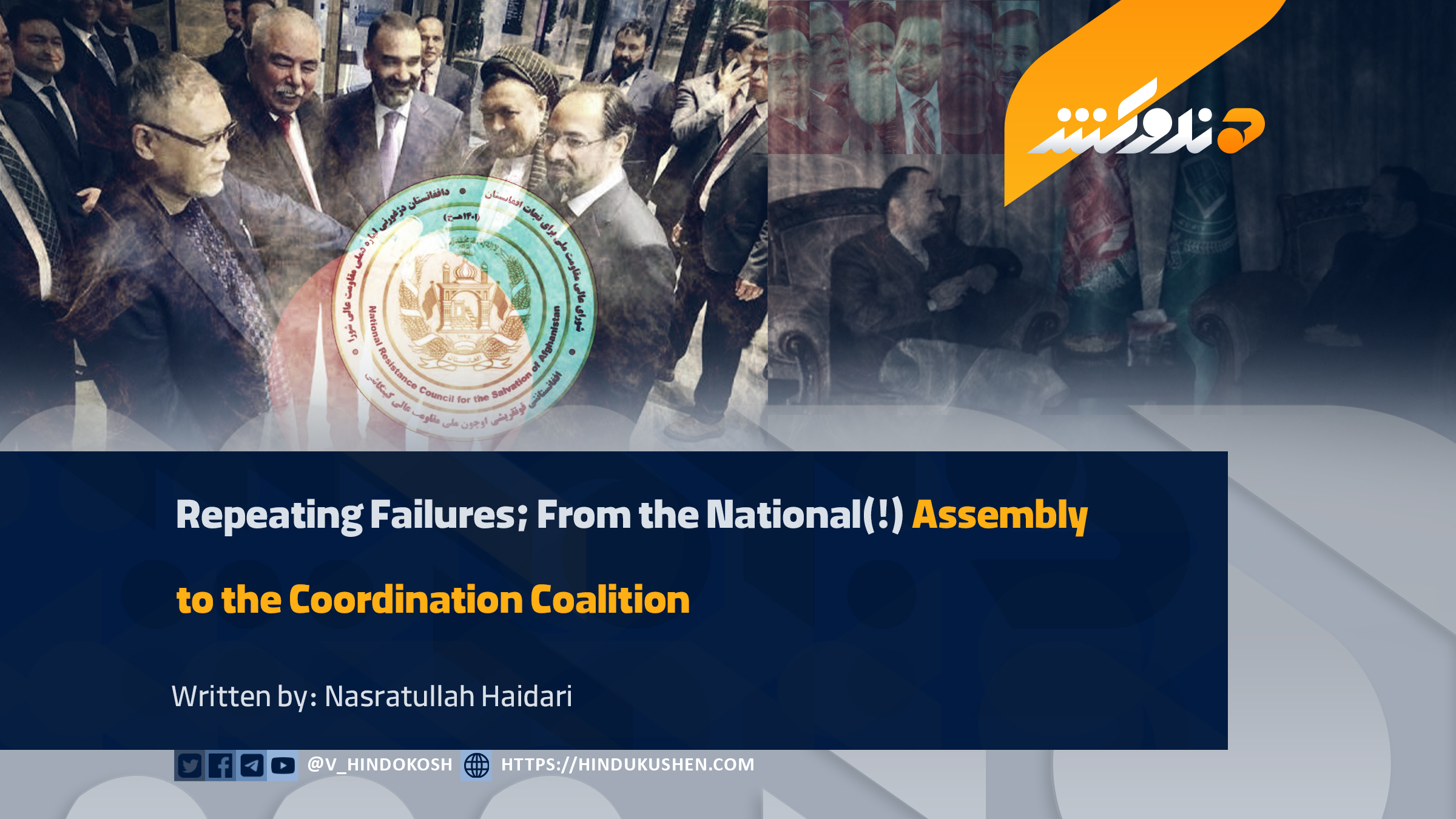
After the collapse of the republic regime and the flight of defeated politicians abroad, a widespread effort was launched by them to rebuild their political identity. Every individual and group tried to reintroduce themselves as a political alternative by creating movements, parties, and numerous coalitions, and to benefit from the financial and intelligence assistance of countries that do not tolerate the stability of Afghanistan. However, these efforts were met with indifference from foreign supporters right from the start, and their dream of returning thru Western support was dashed.
Following this neglect, a coalition of opposition groups and figures decided to temporarily set aside all past, exhausting differences and unite under a single umbrella called the “Coalition for the Coordination of Afghanistan’s Political Parties.” Although presented on the surface as a savior project for their fans, this title neither managed to create a miracle among political opponents nor was it accepted as a credible solution by their foreign supporters. On the contrary, old and new disagreements quickly sprouted and took root within the council.
In this continued pattern of failures, this time the Resistance Council and a number of other leaders of the Republic, including Hanif Atmar, the leader of the Peace and Justice Party, have announced the formation of a new coalition called the “Political Parties Coordination Coalition.” This coalition appears to be nothing more than a repetition of the same failed scenario from the past, a play on words, and a cover-up of the same dead and ineffective structures as before under a new name.
One of the key points of division within this council is the withdrawal of a significant faction, under the name “Jamiat Party” led by Salahuddin Rabbani, who considers himself the leader of this party after the death of his father, Burhanuddin Rabbani.
The Jamiat Party, led by Salahuddin Rabbani, announced its withdrawal from the council in an official statement, citing worse approaches by specific parties within the council and inconsistent and incoherent alliances that contradict national interests.
On the other hand, another prominent group of the Jamiat party, led by Atta Mohammad Noor, who considers himself the legitimate leader of Jamiat, remains part of the Resistance Council’s leadership. The continued presence of Atta Mohammad Noor in the council, alongside the official departure of the Rabbani faction, is a clear example of the same division and uncertainty that has plagued Jamiat and other opponents for years.
The constant disagreements and worse competition for points and self-promotion prove that none of these figures can tolerate or accept the others and that each circle revolves solely around its own personal and group interests.
The formation of temporary alliances and the holding of showy gatherings are all signs of the severe erosion and internal collapse of these movements. These aimless efforts are solely undertaken to prevent being forgotten in the political and media landscape.
Whenever these groups experience internal collapse and failure, they resort to new naming and superficial repairs to repaint their worn-out image.
If they had collective wisdom and the capacity to get along with each other, they wouldn’t be buying a new name every day, and after four years of wandering, they wouldn’t still be stuck in the same initial deadlock.
The truth is that fugitive figures have no clear vision, credible strategy, or genuine feelings for national interests. The core of their thinking is “self-interest,” and this is why every door they open leads to another dead end.
Their recent clumsiness and movements, rather than being a sign of strength, indicate the last gasps and final breaths of currents that have neither a popular base nor the foreign support they once had.
Note: The articles, essays, and comments published by the Voice of Hindukush only reflect the views of the authors & writers and do not necessarily represent the agreement of the Voice of Hindukush.


