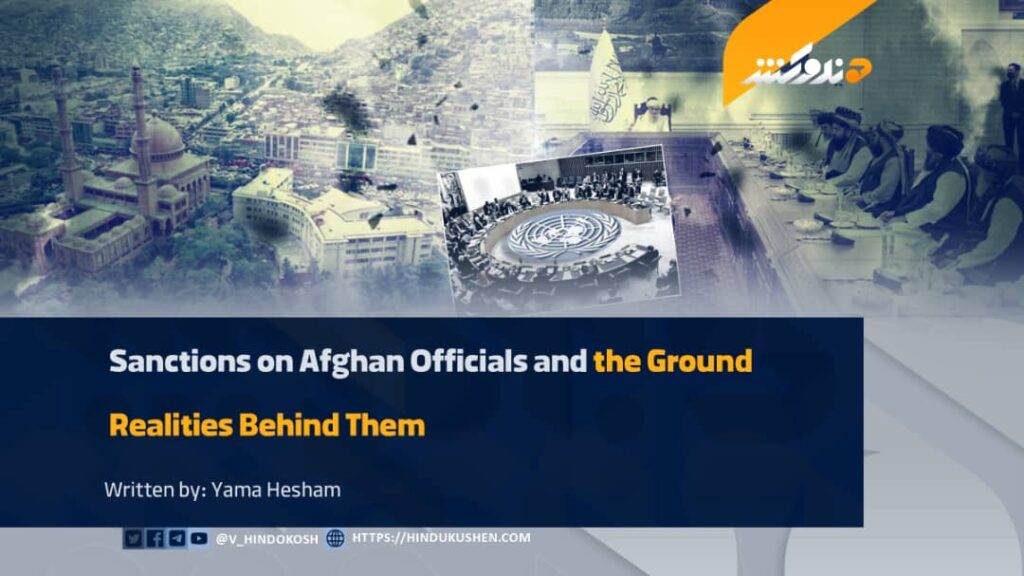





Written by: Yama Hesham
The issuance of a new sanctions list based on the UN Security Council Resolution 1988, which includes 22 key ministers and leaders of the Afghan government, is one of those contradictions in international politics that is far from reality. These sanctions are ineffective because the targeted individuals do not have personal assets or bank accounts in any foreign country other than Afghanistan. When there is no target, such arbitrary sanctions have no other fate than to remain in the void.
In previous administrations, officials had properties and accounts in foreign countries, which they feared would be subject to sanctions, but the current system’s leaders are completely reliant on the domestic economy and independence. Therefore, their decision to freeze assets is like someone trying to catch fish in a dry desert. International organizations are still judging the leaders of Afghanistan’s new government by past standards, which is a major miscalculation.
On the other hand, the foreign relations policy is structured in such a way that there is little need for first-class leaders’ trips. The Ministry of Foreign Affairs conducts all diplomatic affairs with the world as a single and active address. When a ministry can properly represent the entire system, the travel ban on other ministers remains just a letter on paper, which does not create any obstacles in practical diplomacy.
Another undeniable fact is that the top officials in the current government are mostly engaged in internal stability and public service matters. For them, domestic stability and strengthening the system take precedence over foreign tours and ceremonial trips. When first-class officials choose to stay within the country voluntarily, imposing a travel ban on them is essentially closing the door on someone who had no intention of leaving their home in the first place.
Another major obstacle to the UN list is that second-tier government officials, deputies, and technical personnel freely attend international meetings, share the country’s needs with the world, carry out technical and professional tasks, and engage in interactions. This division has caused both the country’s affairs to continue and the United Nations sanctions to become meaningless. This technical ingenuity shows that the government has found ways to grow and operate even amidst international restrictions.
In short, we can say that these sanctions are a waste of time for the United Nations. If these measures had any impact, at least one positive change would have occurred in such a long period. The current reality is that Afghanistan’s top officials neither have investments abroad nor are most of their activities tied to foreign trips. Instead of using failed pressure tactics, the world should recognize that such lists have no impact on the stability of the government or the resolve of the leaders, and priority should be given to constructive engagement and unrestricted relations.
Note: The articles, essays, and comments published by the Voice of Hindukush only reflect the views of the authors & writers and do not necessarily represent the agreement of the Voice of Hindukush.