








Written by: Anas Majeedi
In recent times, Pakistani media and official platforms have repeatedly attempted to portray the ongoing resistance in Balochistan as a “foreign-backed plan,” claiming that the leadership of Baloch armed groups operates from Afghanistan. This narrative is not only far removed from factual evidence, but has also become an easy way to conceal Pakistan’s security and political failures. Ground realities show that the main Baloch leadership and decision-making circles are present inside Balochistan itself and are directing the course of the conflict from there.
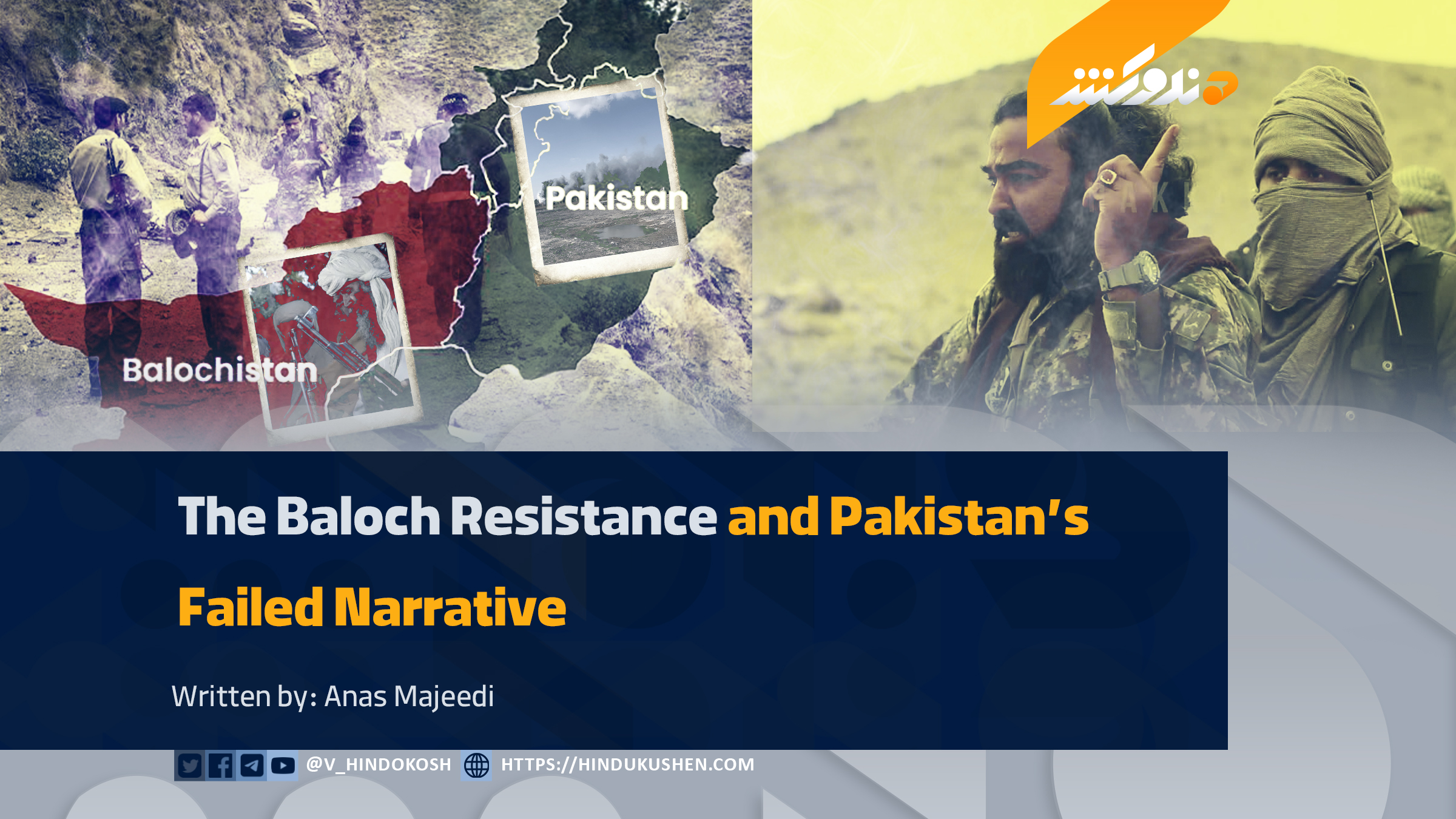
Recently, Baloch armed groups carried out coordinated attacks simultaneously in several cities of Balochistan, plunging Pakistan’s security institutions and military into serious disarray. In a recent video circulated in the media, the group’s leader, Bashir Zeb, is seen appearing in a mountainous area of Balochistan. These pieces of evidence have reduced the linking of this group to Afghanistan to nothing more than a propagandistic and baseless claim.
If the roots of this conflict within Pakistan are examined, it becomes clear that the ongoing violence between the Baloch people and Pakistan is the result of years of internal oppression, political disenfranchisement, and military coercion. Enforced disappearances, widespread military operations, ruthless exploitation of natural resources, and the deprivation of Baloch people from their basic rights are the factors that have given rise to this resistance. This war has neither been imported from outside nor initiated at the behest of any other country; rather, it is Pakistan’s own military policies that have kept the fire of opposition burning.
In this context, Afghanistan has consistently maintained and demonstrated the stance that it does not interfere in the internal conflicts of other countries. Neither is the Baloch struggle being directed from Afghan soil, nor has the Afghan government supported this conflict, nor has the Baloch leadership been given refuge here. Accusations leveled by Pakistan against Afghanistan may be an easy political pretext, but they carry no weight from a legal or factual standpoint.
The ongoing Baloch resistance should be analyzed within the framework of Pakistan’s internal crisis and should not be linked to the names of foreign countries. This resistance is a struggle for identity, land, and basic rights, and it reflects the flawed policies that have kept the people of Balochistan under pressure for decades. Attributing this war to Afghanistan is merely an escape from confronting the real problem.
Interestingly, the same Pakistani media circles that previously claimed the Baloch leader was in Afghanistan have now themselves reported his appearance inside Pakistan. This reality clearly shows that earlier claims were largely political propaganda rather than ground realities. Such contradictions have further weakened the credibility of Pakistan’s official narrative and raised serious questions about all of its claims.
As long as Pakistan’s military regime continues to view the legitimate demands of the Baloch people through a security lens instead of political rationality, this conflict will not be resolved by manufacturing foreign excuses. Invoking Afghanistan’s name is neither a solution to the war nor a realistic way to reduce violence. The resolution of this crisis is only possible when Pakistan acknowledges its historical mistakes and addresses the Balochistan issue through an internal, realistic, and just understanding.
Note: The articles, essays, and comments published by the Voice of Hindukush only reflect the views of the authors & writers and do not necessarily represent the agreement of the Voice of Hindukush.


