








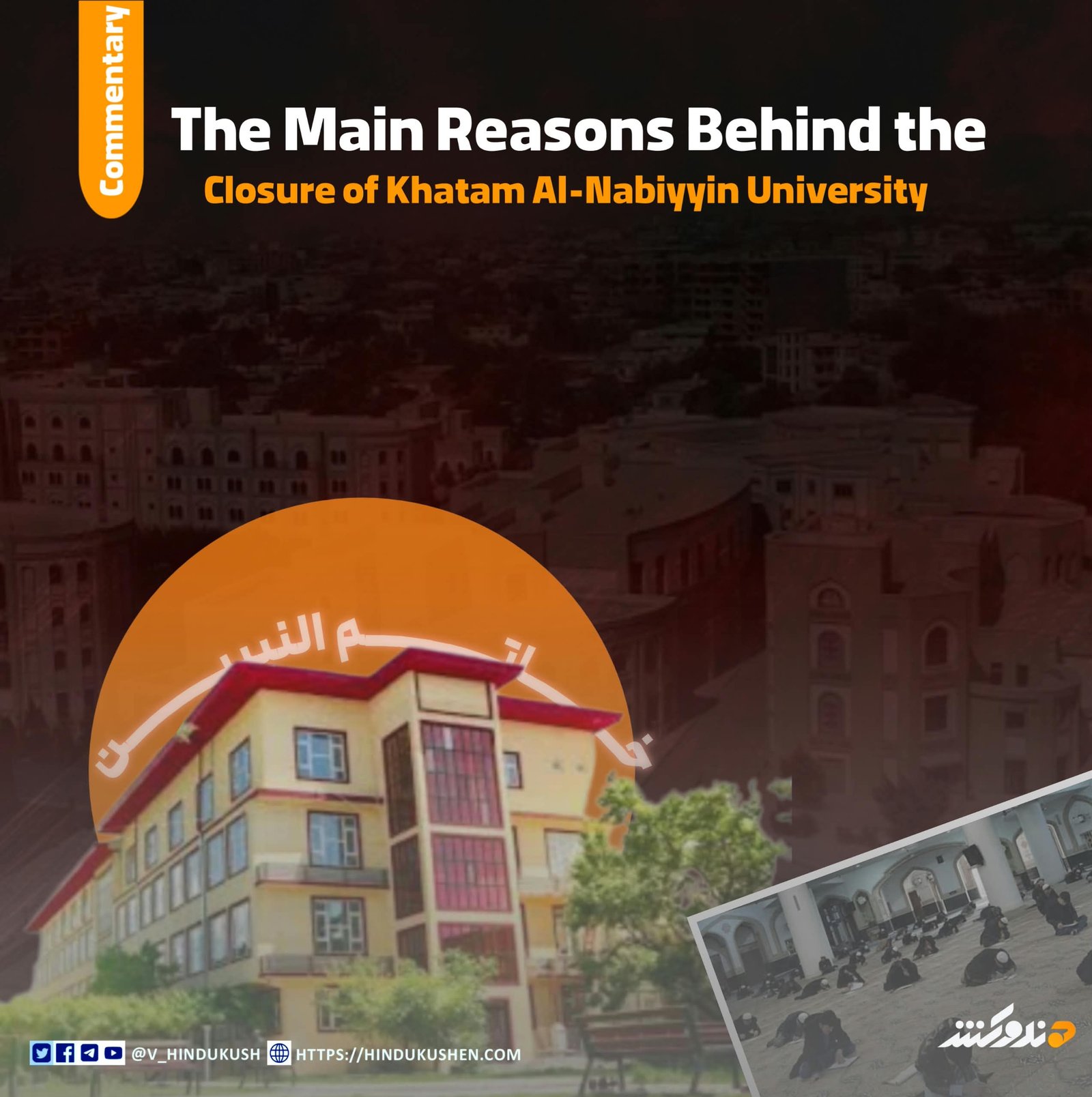
The suspension of activities and the revocation of the license of Khatam Al-Nabiyyin University in Afghanistan is one of the important decisions in the country’s educational sector. The Ministry of Higher Education has various Sharia, cultural, and principled reasons behind this decision. This decision is based on regulations, laws, and the principles of Sharia, in order to keep the academic environment free from ideological distortion and legal violations.
The first and most important reason for the suspension of the university’s activities is the neglect of native linguistic terms and the promotion of foreign words. The Ministry of Higher Education has clearly stated in its policy that all educational institutions are obligated to pay attention to the national and official languages of the country and to avoid the use of foreign terms. This issue has also been communicated according to a decree from the leadership of the Islamic Emirate, which includes an order to avoid the use of foreign terms. But the mentioned university has not clearly refrained from using the term “دانشګاه” and other similar foreign terms.
The second major reason is the negligence and blatant disrespect toward religious rituals and Islamic sanctities. Sharia and Hanafi jurisprudence are fundamental pillars in the current system of higher education. Based on the findings, books, research articles, and monographs that distort religious values or violate Islamic laws are considered a major offense from a Sharia perspective. According to the ministry’s principles, all academic works must also comply with Sharia principles and ethical standards.
Precise examples of the distortion of sacred texts were present in various printed chapters and educational materials of Khatam Al-Nabiyyin University. Based on the findings, the mention of the blessed name of the Prophet Muhammad, the savior of humanity and the great prophet, was done in a manner that was neither fitting nor appropriate for his exalted status, while honorific titles were used for some leaders and figures of the Shia sect. This act is an unforgivable insult to religious sanctities and a harm to stability.
In addition to the aforementioned points, the misuse of the academic environment for a specific ideological and religious direction is also a reason for the university’s closure. According to the principles, all universities should be centers of fundamental education, not centers for the promotion and dissemination of specific political, religious, or ideological movements. The findings also indicated that students were being directed toward foreign ideologies, deviant religions, and political movements in monographs and other articles, contrary to all principles.
By revoking the license of Khatam Al-Nabiyyin University, the Afghan government has shown that it wants all educational institutions to operate within the framework of unified Sharia law, principles, and values, and to provide principled and lawful educational services to society. However, those who cross these lines will be prevented. This step is completely commendable, as it is taken with the intention of preserving linguistic and intellectual independence, and on the other hand, it is a clear path to upholding principles and high-quality, impartial academic standards in the educational sector.


