








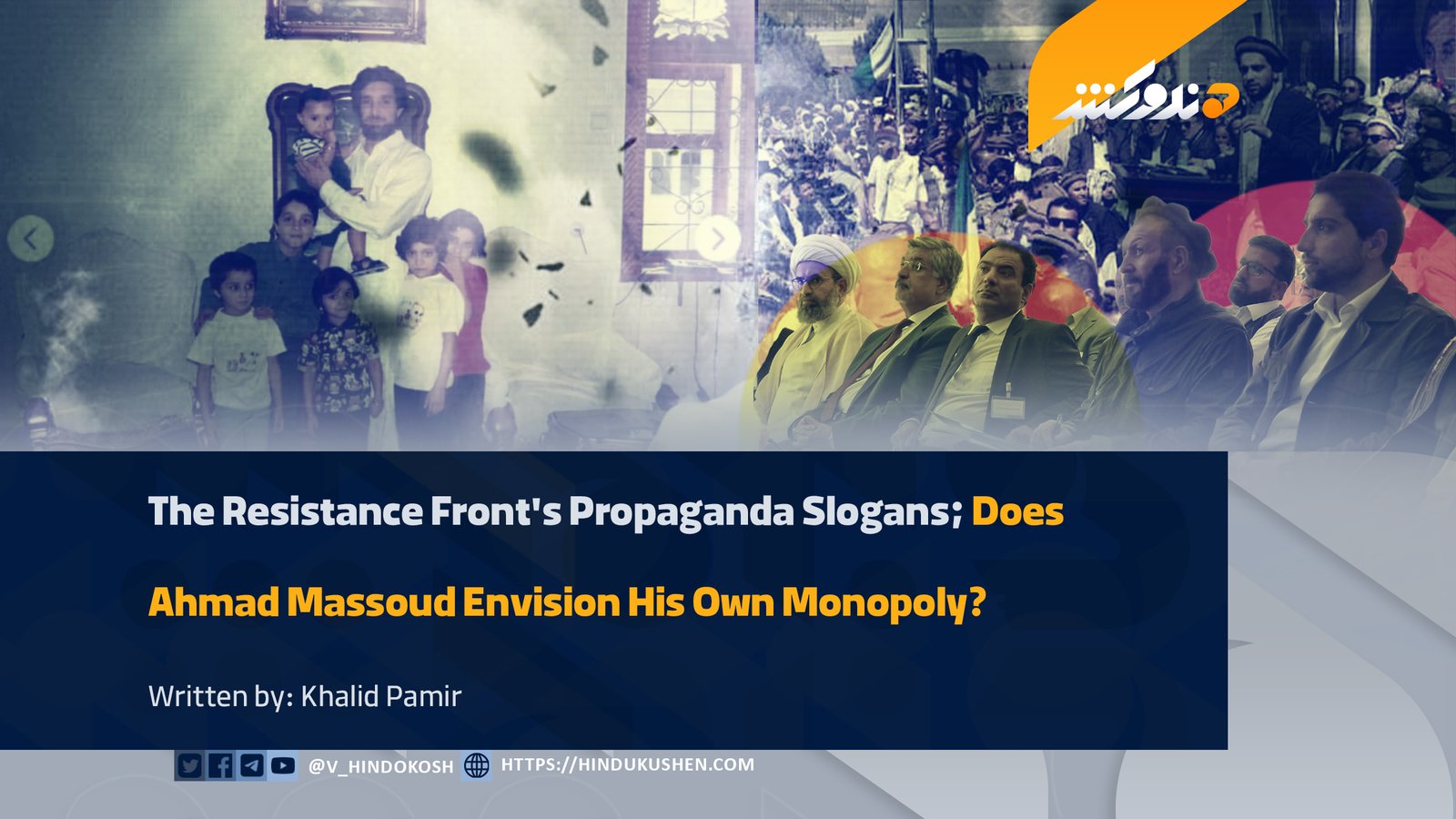
Written by: Khalid Pamir
In his recent online speech, Ahmad Massoud boldly criticized the Afghan government for its monopoly on power, but this criticism, when compared to their own organizational structure, encounters a significant historical and political contradiction. The biggest point of contradiction in Massoud’s imaginary front is that his own leadership’s legitimacy(!) is not the product of any kind of free process, but rather attained power thru familial politics, and now he is the leader of a group based on the same principle.
How is it possible for a leader to claim breaking the monopoly while relying on inheritance and family legacy themselves? If Massoud is removed from the membership of the Ahmad Shah Massoud’s exclusive family, then Ahmad will be an ordinary person, someone who wouldn’t even be accepted as the leader of a small group. It was the actions of Ahmad Shah Massoud that brought his son Ahmad to lead a group called the Resistance. It’s just that he is taking advantage of his father’s name.
The leaders and decision-making powers of the sub-foundations of this fictional group called the Resistance are limited to a narrow ethnic and geographical circle, a circle that has shown disdain for them for years. In a multi-ethnic country like Afghanistan, talking about diversity and participation by a group that appears to be confined to a limited circle means excluding the people. Massoud cites the names of ruthless, murderous warlords who were themselves the founders of the islands of power and ethnic monopoly to support his claims.
Such claims remind the Afghan people of the failed political deals and alliances of those politicians who, over the past two decades, monopolized the country’s wealth and power among a few limited families and political traders. The Massoud group is another form of the remnants of those former failed political figures who want to pave the way to regain power under new terminologies. The mention of those politicians who now have no practical influence within the country is merely a reminder of past failed experiences.
As long as they do not demonstrate practical examples of diversity, and transparency within their groups, Massoud’s words will remain as propaganda of a group that uses all kinds of tools to garner public support. The people now understand the difference between slogans and actions, and they question why, if Massoud and his group truly believe in participation, there are no new thinkers in their front except for a specific family and faction, and they still rely on the old warlords?
According to Ahmad Massoud, the literature of participation has lost its significance under the shadow of his organizational monopoly and hereditary leadership. This group cannot be a bearer of the message of justice and equality for the new Afghanistan, because their very foundation is supported by the old defeated and monopolistic figures. If this group wants participation, it must start with itself, presenting a true form of participation within its own group and removing its structure from a specific ethnic and geographical circle. Otherwise, its calls for rejecting monopoly will only be a political facade and a propaganda tool.
Note: The articles, essays, and comments published by the Voice of Hindukush only reflect the views of the authors & writers and do not necessarily represent the agreement of the Voice of Hindukush.


