








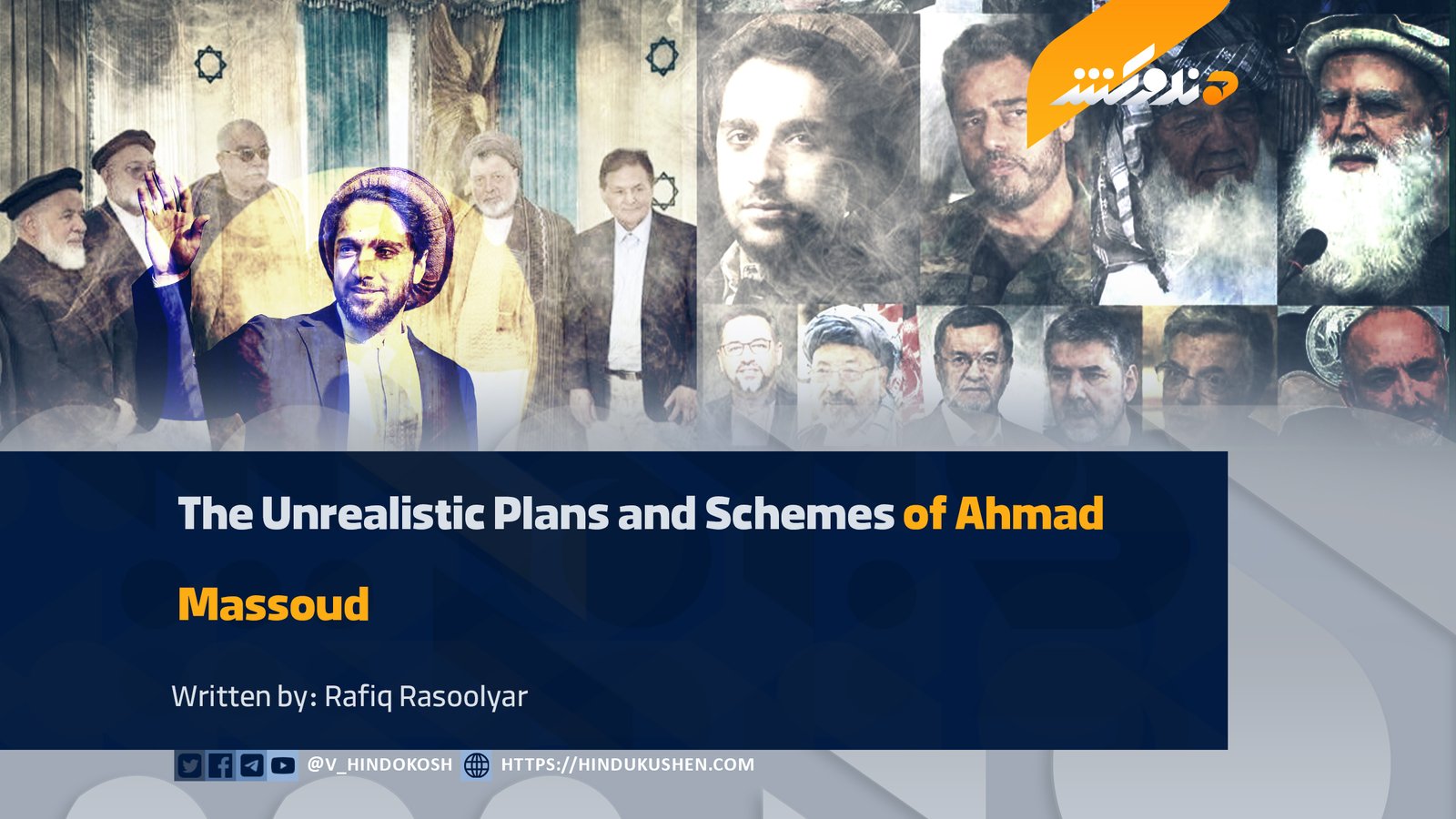
Written by: Rafiq Rasoolyar
The leader of the imaginary Resistance Front, Ahmad Massoud, in his recent statements, spoke of an alternative and political process for Afghanistan that, from a distance, shows a gap between the ground reality and mental perception. When such a political process lacks the ability to control a vast land and establish a geographical presence within the country, high concepts like an alternative government, a constitution, elections, and others can only be effectively utilized in exile to keep oneself occupied. Politics is not created by slogans, but by presence in the field; something that Massoud and his imaginary group are completely deprived of.
Massoud’s claim that “the alternative to the Afghan government is not an individual, but a national and legal process” actually reveals the significant gap that the opposition is grappling with internally. Despite the passage of the past five years, the opposition has not been able to establish a popular, legitimate, and legal process, because the representation of a stable political alternative and process is impossible without the organization of the public masses and the possession of geographical power; likewise, each opposition member considers themselves an alternative, but they deny each other.
The biggest problem of the opponents is that they have limited the definition of their existence to propaganda on social media and participation in some meetings. But in the face of the Afghan government’s military and political supremacy, which currently has complete control over the entire country, the idea of such opponents, whose residences are even outside the country, planning a new regime is politically laughable and far from reality.
On the other hand, Massoud’s reference to the will of the people is a political exploitation of this high concept. How can the so-called resistance group represent the will of the people within the country, when the physical, political, and geographical connections between them and the Afghan people have completely disappeared? As long as a movement does not have social and physical roots within the country, it cannot represent the will of the people, and any of its plans will be limited to online gatherings.
History has proven that processes managed from afar and relying on imaginary slogans can never influence the political fate of a country. Another major weakness of this group is that it tries to hide its reality behind political jargon. They try to compensate for their military and operational defeat by using theoretical discussions and modern terminology to present themselves to the world as an alternative to the current situation, but they have no legitimacy, practical power, or mechanism to initiate this process.
Any political process and theorizing that clash with the ground reality are doomed to failure. Masoud’s group’s fanciful plans do not have followers within the country because the people do not trust their practical power. Drawing up a plan for Afghanistan’s future from abroad and expecting a process based solely on assumptions is the clearest evidence of the resistance group’s strategic ineptitude and their escape from the ground realities.
Note: The articles, essays, and comments published by the Voice of Hindukush only reflect the views of the authors & writers and do not necessarily represent the agreement of the Voice of Hindukush.


