








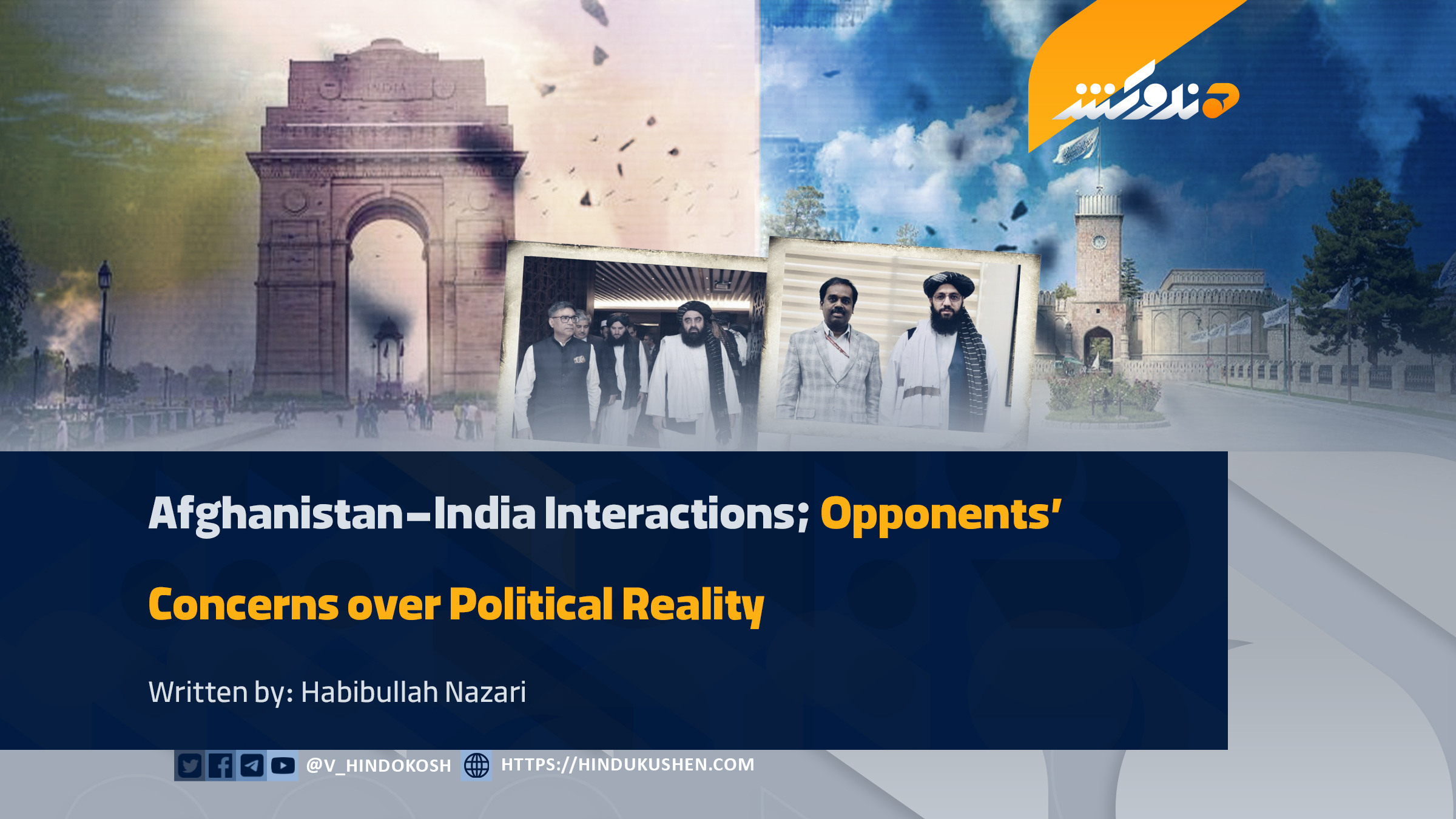
Written by: Habibullah Nazari
After taking political control of the country from the occupying forces and structures affiliated with them, the Islamic Emirate of Afghanistan, with its approach of political awakening and the adoption of a balanced foreign policy, was able to establish relations with regional and international countries in a short period, despite efforts to isolate Afghanistan, and to reestablish its political standing as an independent and stable country at the international level.
Within the framework of this approach, Afghanistan’s relations with the Republic of India have entered a new phase of diplomatic cooperation. In recent days, the Indian Ministry of External Affairs announced its readiness to hand over the Afghan embassy to the official representation of the current Afghan government, following which “Noor Ahmad Noor” was sent to New Delhi as the official representative of the Afghan government.
In contrast, some political factions opposed to the current Afghan government have expressed concern and criticized the expansion of these relations. Among critics, Fawzia Koofi is also among the infamous figures of the republic.
He criticized New Delhi, saying, “Legitimizing the Taliban weakens democracy and human rights in Afghanistan.” She also stated that “diplomacy without accountability strengthens repression.”
Fawzia Koofi criticizes India while New Delhi is recognized as a knowledgeable country in global diplomatic relations, understanding international realities better than any puppet or sellout.
However, as a conscious player in the global political arena, New Delhi has decided to pursue practical and reality-based diplomatic relations, taking into account the existing realities in Afghanistan and the region. From India’s perspective, the government currently established in Kabul represents the true structure of power and sovereignty in the country, and any responsible engagement with Afghanistan must inevitably consider this political reality.
India, aware of the differences in political systems and the values governing societies, knows that Afghanistan’s legal and cultural structure is based on an Islamic interpretation of government and law; an interpretation within which the rights of all segments of society, minorities, and ethnic groups are observed in light of the Islamic system, not based on Western democratic models. Accordingly, instead of denying these facts, New Delhi has chosen the path of interaction and dialog.
The relationships of countries with Afghanistan show that many of them have come to understand that the real party for dialog and the practical representative of the Afghan nation is the current government of that country. They also understand well that those who oppose establishing diplomatic relations with the current government are more likely to be seen as actors affiliated with the intelligence circles and organizations of global powers rather than as genuine representatives of the Afghan people. Based on this, countries have increased their political and economic relations with Afghanistan, and these interactions are expanding day by day.
Note: The articles, essays, and comments published in Hindukush Voice only reflect the views of the authors, and do not necessarily represent the agreement of Hindukush Voice.


