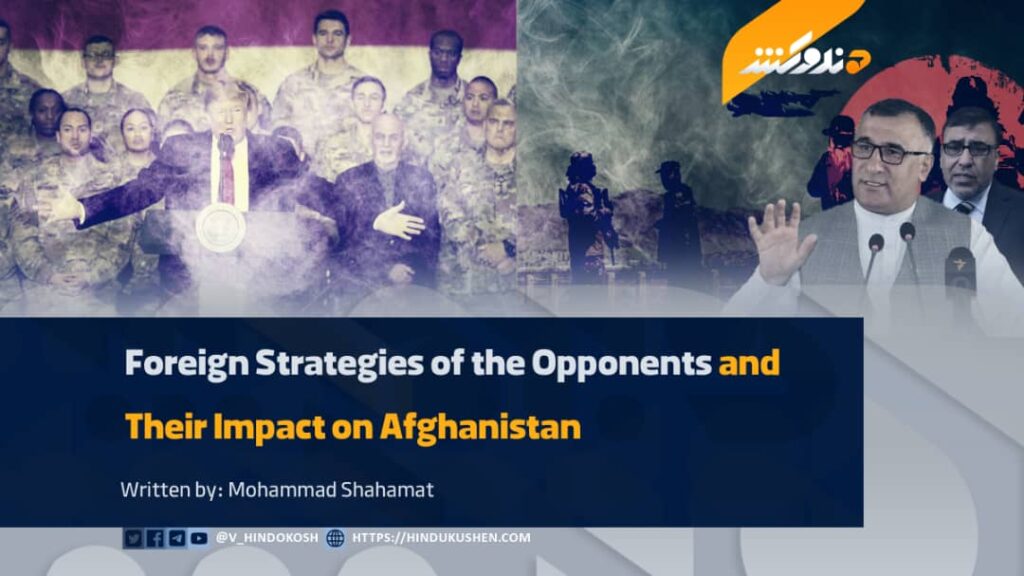





Written by: Mohammad Shahamat
After the occupying forces were driven out of Afghanistan and sovereignty was handed over to the true sons of this land, their dependent and sycophantic circles were inevitably forced to flee. These individuals, who have always sought their political survival in the shadow of foreigners, have once again turned to foreign powers and are attempting to pave the way for their return to power with imposed and transactional schemes; schemes that, in essence, amount to bargaining away the national values and sovereignty of the country.
Given the bitter and costly twenty-year experience of the United States and its allies in Afghanistan, this time, the approach of direct confrontation has given way to the use of proxy tools. In this context, Pakistan, as one of the key players with a long history of regional interventions, has once again become central to this equation.
The role of this country in supporting, directing, and managing certain opposition movements can be analyzed within the framework of regional geopolitical competitions.
The scattered and defeated opponents who suffer from a lack of popular support and political capacity are now attempting to bring insecurity and instability back to the country by presenting “external solutions.” These plans mainly take shape in the form of behind-the-scenes meetings, media programs, and intelligence operations; but the fundamental question is, to what extent can these efforts change the ground realities of Afghanistan?
The reality is that repeating past tested solutions, without considering the current social and political developments in Afghanistan, has little chance of success; because the groups and figures who gather outside the country today and conspire with Pakistan and the United States for their return, not only lack the necessary cohesion, but also face deep internal conflicts.
The differences among some figures associated with the collapsed Republic, including the ideological and political tensions among individuals like Miakhail, Fidai, and Nengial, indicate that there is no consensus even in the path of dependency and cooperation with external forces. These divisions have further weakened their practical capacity.
On the other hand, some prominent figures of the previous republic have also taken a critical stance toward such efforts, deeming them lacking in national legitimacy. This issue shows that even among the opponents of the current regime, there is no unified consensus on “Foreign Strategies.”
On the other hand, the unity and cohesion of the mujahid and invincible Afghan nation against the interference of internal opportunists and the scheming powers of the region and beyond, and anyone who seeks to destabilize and create insecurity in Afghanistan, indicates that any sinister plan of Afghanistan’s adversaries will fail against the will and determination of the people of this country.
Yes, it can be said with certainty that no conspiracy, plan, or external prescription, even with the support of regional and trans-regional powers, has the ability to withstand the realities on the ground in Afghanistan and the steadfast determination of its people; rather, such efforts will not only fail to achieve their goals but will ultimately be marked with the stamp of defeat and humiliation on the foreheads of their planners and executors, once again proving that the will of the Afghan people is the final determinant of the fate of this land.
Note: The articles, essays, and comments published by the Voice of Hindukush only reflect the views of the authors & writers and do not necessarily represent the agreement of the Voice of Hindukush.