








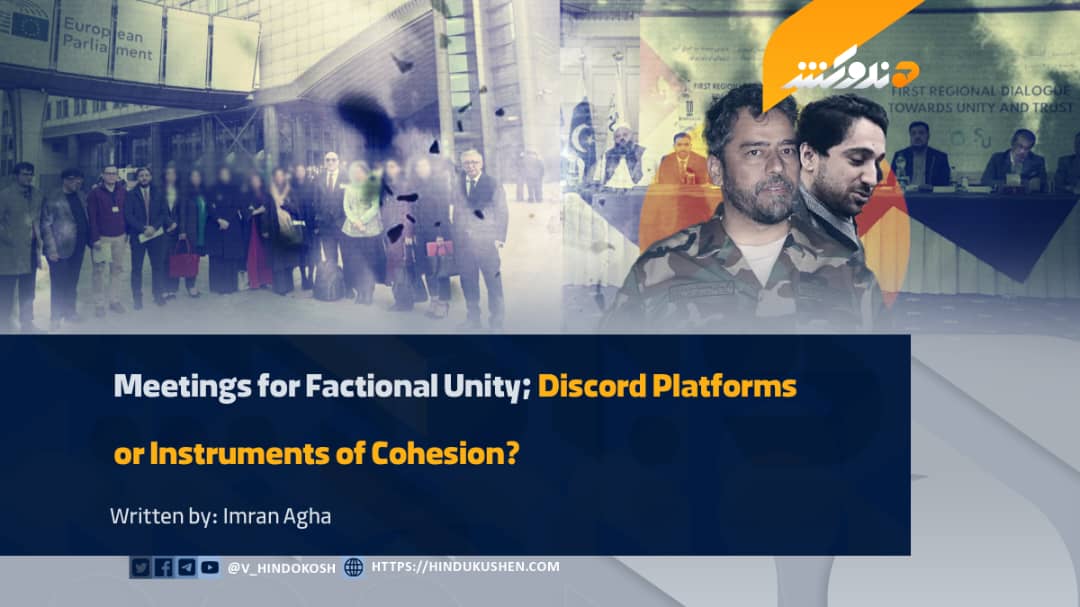
Written by: Imran Agha
In the analysis of contemporary political movements, a fundamental principle is that “unity” is not achieved thru slogans, but rather thru structural coordination, unified leadership, and a common vision. In the recent statements of opposing factions against Afghans, particularly the emphasis on unity by Yasin Zia, it is, in fact, an implicit acknowledgment of the existing fragmentation within these factions. If a movement is naturally free of differences and cohesive from the beginning, then there is no need for repeated calls for unity; instead, all its focus is on achieving its goals.
Every political or military structure remains stable when there is a balance between “purpose and leadership.” In these fronts, there is no coordination between these important elements; the goals of these fronts are ambiguous and lost, and their leadership is fragmented. This situation has led to the systematic instability of these fronts.
The differences between the factions are not personal but structural in nature. The distribution of resources, management of foreign relations, and definition of political narratives are the three main pivotal issues over which there are ongoing disputes among these factions. The resources of these factions, especially financial resources, are in the hands of a limited circle, and these resources are provided to these groups from various addresses to implement different conspiracies against the Afghan people.
The structure of the opposition fronts is such that their relations have gone beyond management, meaning that each responsible person tries to reach out to every direction to obtain money and build their personal life on it. These officials, who receive financial support from various sources, very few reach the ordinary members; this is the reason why the number of members and supporters of these fronts decreases day by day, and the improper distribution of financial resources causes major conflicts among them.
The opposing fronts also do not have a precise and unified narrative, nor can they create one; they cannot create a unified narrative because they do not have a unified goal, each is trying to find ways to enhance their personal comforts. When values differ, disagreements shift from a technical state to a fundamental one. This is why there is no unified definition of values between opposing fronts. Since they do not recognize values, differences also arise in their perspectives and goals.
A key sign of political cohesion is that differences are resolved, managed, and minimized within political movements and are not largely media-driven. However, if the resolution of differences and the establishment of unity are brought up thru the media, it indicates that cohesion does not actually exist and they cannot even gather all their supporters and like-minded individuals in one assembly. The opponents are currently facing such a situation.
The Afghan government’s opposite fronts emphasize their internal unity in all their meetings. The strong emphasis on unity indicates that they do not yet have internal unity. If they had internal unity, they would be able to discuss other issues. However, these groups cannot address other fundamental issues and instead try to prove their existence and survival thru these so-called meetings.
Movements that are solely based on opposition can never create an alternative system; the sole aim and concern of the opposing factions is merely to oppose the Afghan people and the Afghan government; this situation indicates that these factions have no plans or programs for their future.
In contrast, the central leadership plays a key role in the structure of the Islamic Emirate; the centralization of decision-making, a unified vision and effective narrative, the clarity of the organizational hierarchy, and the principle of obedience are the factors that have prevented internal divisions, brought peace to all of Afghanistan, and strengthened the pillars of the Islamic Sharia system.
Note: The articles, essays, and comments published by the Voice of Hindukush only reflect the views of the authors & writers and do not necessarily represent the agreement of the Voice of Hindukush.


