








Analysis
Written by: Zeeshan Jameel
Introduction:
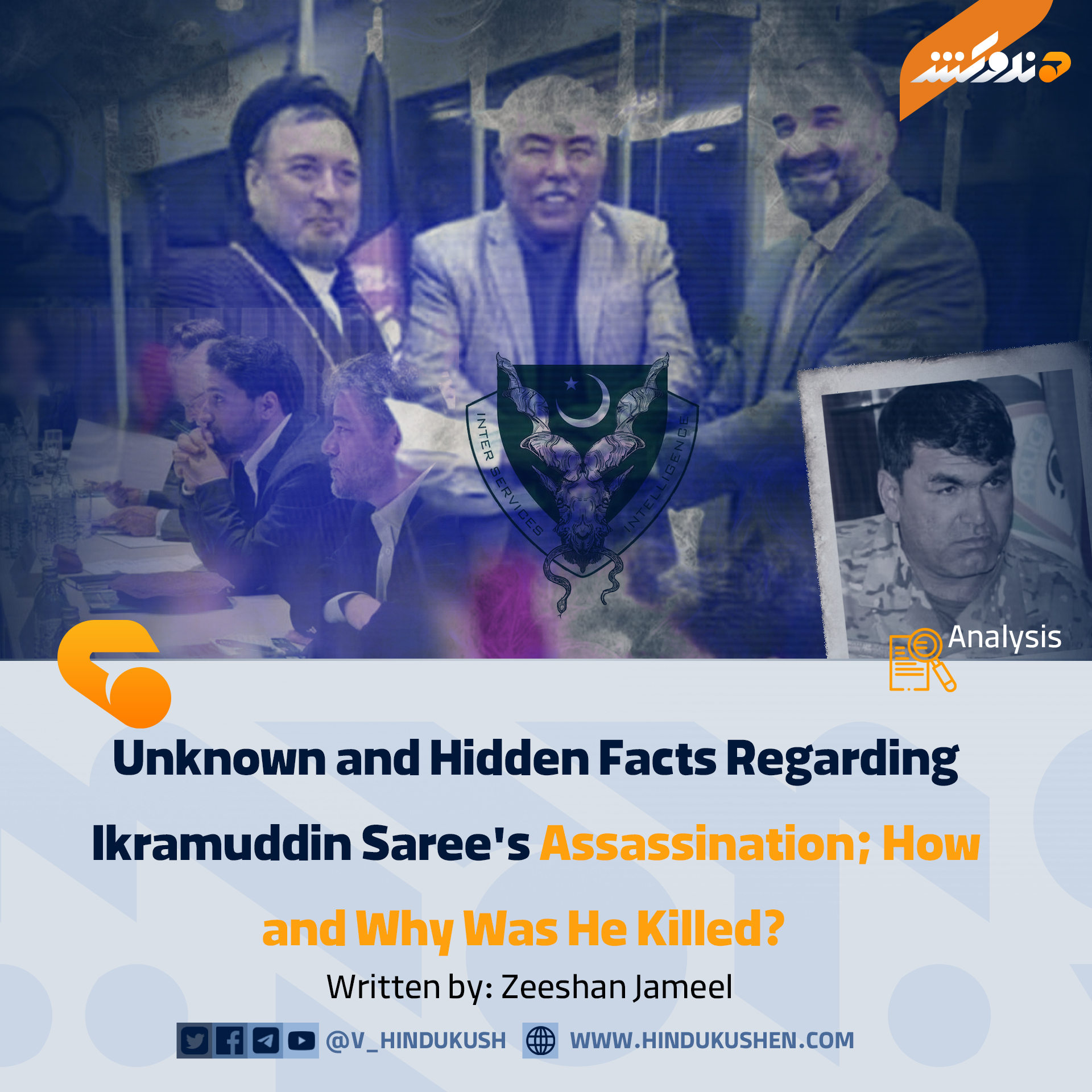
General Ikramuddin Saree, the police commander of Takhar province during the fallen republic, and a prominent Iran-based commander of the Resistance Front, was targeted by unknown gunmen along with one of his coworkers at nine o’clock on the evening of Jadi 3rd while returning home from his office on Vali_Asar Street in Tehran. He passed away while being taken to the hospital.
The Assassination of Saree is a significant issue, which is why it has attracted the attention of the media, analysts, and commentators, as there are issues behind this targeted killing that require further investigation, exploration, and clarification. This killing appears to be the elimination of an individual, but in reality, it was organized crime by a group that did not want him to advance further and become their competitor.
Saree’s Identification:
Ikramuddin Saree was a native of the Kohistan Hissa_Aawl district in Kapisa province. He completed his military training in Kabul during the fallen republic and held several positions within the Ministry of Interior. After serving as the director of some security zones in Kabul province, he first served as the police commander of Baghlan province and then as the police commander of Takhar province.
After the fall of the Republic, he fled to Iran and settled there in Tehran; after the defeat of the Resistance Front in Panjshir province, Ahmad Massoud and his group attempted to recruit and utilize military personnel based in regional countries for their objectives. Saree, who had already joined this group, was carrying out activities in Tehran for the goals of the Resistance Front; it is worth mentioning that recently, the Iranian government has restricted the activities of opposition groups to the Afghan government.
Saree’s Hiden Activities, Requests and Concerns:
Although Ikramuddin Saree was considered an important commander of the Resistance Front and had a close relationship with it, he also had good relations with the “Freedom Front” led by Yasin Zia. Saree recently formed a council called “The Great North,” which he said would help Afghan refugees, especially former military personnel, obtain residency and other documents. Saree had gained considerable influence thru this council and was known as an influential commander among former military personnel.
So, what happened behind the scenes and the realities that were revealed and could not remain hidden. This council, thru Saree, was establishing contact with former military personnel residing in Iran, assisting them in obtaining residency cards and other documents, using this as an illegal source of income, and obtaining large amounts of money thru it. It was also said that he was exploiting the former military personnel’s vulnerabilities to recruit them for the resistance front and other opposition groups thru this council.
These two actions raised different concerns from various perspectives; the resistance fronts feared that the Saree’a would quickly gain influence among former military personnel and had formed a council for this purpose, which they considered a separate group. This hindered the recruitment process for the resistance fronts and cut off their contact with refugees residing in Iran. Additionally, these fronts realized that the Saree’a had gained sufficient influence.
Commander Malik Tatar also referred to this issue in his speech, stating that everyone was forming groups; in other words, group formation was a point that had attracted the attention of others and led to the creation of opposition, as a separate group was the cause of Saree’s influence. This commander also warned Saree that he held him accountable for thefts and other information about former military personnel.
Saree gained considerable popularity among former military personnel thru his council, a popularity that, while beneficial, also had its drawbacks. Recently, Pakistani intelligence (ISI) has been inviting military personnel from the fallen republic, residing in other countries, to Pakistan thru a project, General Jurrat, General Abdul Matin Hussain Khail, and several other former military officers, to fight for the interests of the ISI.
Thru this operational project, Pakistani intelligence wants to consolidate former military officers and generals and use them in various fields, such as threatening Afghanistan’s security, creating planned attacks on Afghanistan’s borders with other countries, deteriorating Afghanistan’s relations with neighboring countries, and carrying out other intelligence activities. Saree, who was an influential general among the military, was invited by ISI Pakistan, but he did not accept this invitation and also prevented other officers from doing so. The second offer to him was to damage the good relations between Afghanistan and Iran thru attacks on Afghan representations in Iran. However, since Saree did not accept these offers, ISI, along with other groups, planned his assassination.
Saree, who also had good relations with the Freedom Front, offered cooperation to Yasin Zia, but Yasin Zia refused to work with Saree’s friends because, according to him, they were traitors. Zia, who was in serious competition with Ahmad Massoud, wanted to be ahead of this group on the political stage, but Saree was working for Resistance Front, and alongside this, efforts to exert personal influence continued, which caused Yasin Zia’s fear. He was afraid that the Resistance Front would gain more influence and that they would not be defeated in their internal competition.
Saree, with his activities and fast progress, also caused concern among numerous warlords, who saw it as a threat to their future and their influence over former military personnel. General Sherzad, a member of the Resistance Front, admitted that the Saree killing in Iran was due to disagreements within the Resistance Front and with some other opposition groups. In his remarks, he also mentioned concerns about the Saree killing among Ismail Khan, Ata Mohammad Noor, and the Northern Kohdaman Party (which included Massoud, Dostum, Mohaqiq, and some other ethnic groups during the civil wars). Tensions had arisen between the aforementioned groups over the Saree, as his connections expanded and popularity grew, which significantly damaged the influence of these groups.
But on the other side, former military personnel say, Saree created work permits for the soldiers of the fallen republic; these soldiers, who are also members of some other groups including the Resistance Front, claim that Saree collected reputations in this way and sent them to Afghanistan’s security agencies. A commander of the Resistance Front, Agha Rahim Qati, who strongly criticized the generalship of Saree, said that Saree had obtained his generalship thru theft from people’s pockets and thru suspicions. He had taken money from former soldiers, betrayed them, and secured personal gains in this way.
Assassination of Saree:
There are many hands behind the killing of General Ikramuddin Saree: the ISI, the Resistance Front, the Freedom Front, former warlords, and military personnel. Organizations, circles, and groups that did not accept Saree’s destructive proposals were concerned about his activities, felt threatened, or had suffered direct harm from him. Currently, close ties have been established between the opposition groups of the Afghan government and the ISI. They coordinated with Pakistani intelligence to deliberately eliminate Ikramuddin Saree and blamed the Afghan government for his assassination to appear innocent. This estimate reflects the evidence obtained so far.
If we examine the aspects of Saree’s assassination from other aspects, we can say that Saree’s killing presents a picture of the Afghan government’s opponents internal mismanagement of opposing movements and its deep and secret ties with the ISI. This incident is not just the elimination of a commander; on the one hand, it reflects the structural problems that have accumulated within these movements for years, and on the other hand, it is clear evidence of the existence of close cooperation with Pakistani intelligence. The Saree killing also showed that political parties claim political alternatives, but within them, disagreements escalate to physical elimination, so we can consider all this not a coincidence but a planned event.
Within the Resistance Front, the problem is largely that it revolves around individuals rather than political organization. Every commander and every influential figure tries to maintain their independent position. In such an environment, an individual’s influence or popularity is analyzed as a risk to others; General Saree was also caught in this sensitive equation.
Regardless of the disagreements surrounding the accusations made by some former military personnel against the Saree Generalship, thefts, and connections with former military personnel, one fact is clear: the Resistance Front can accuse any member of the front to prevent individual influence, open the door to defamation, coordinate with intelligence agencies to eliminate them, and ultimately eliminate them; this is the clear beginning of the front’s decline.
Believe are Being Damaged:
After the Saree’s killing, a great wave of distrust swept thru the opposition movements; the last audio message of Yasin Zia, which Voice of Hindukush published, shows how far the distrust between the opposition movements and former military personnel has reached! The ultimate level of distrust is when complex passwords are used even in private voice messages and communications.
In his audio message, Yasin Zia said that even their high-ranking colleagues and friends are traitors. According to analysts, this refers to the “Saree’s friends,” those registered under the name of the military and for whom residency cards are issued. Here, not only Zia but every opposition party sees connections with former military personnel as both an opportunity and a threat for these fronts. This is an opportunity because this layer is experienced and a threat because this same layer has also been a source of distrust.
Yasin Zia’s audio message is an admission of distrust, and this admission proves that the problem is not just among mid-level commanders but has reached the leadership level. When elders are suspicious even of their close ones, such a flow can no longer remain a means of change. The use of passwords in relationships and the concealment of internal conversations indicate that political movements have shifted to a state of self-preservation rather than mobilization. This situation generally arises when a movement no longer feels its greatest danger from within.
Saree’s Mistakes:
Humans make certain mistakes in life that are not easily rectified, requiring long-term and arduous work to avoid potential risks. Saree had quickly formed a tribal and regional council, thru which he also pursued biased issues and made maximum use of it for his influence; instead of abandoning this mistake, he continued and repeated this action, which ultimately resulted in isolation and the physical elimination of Saree.
Saree focused on expanding personal influence among his inner circle, friends, and political allies instead of building trust. In a political climate where institutions are weak, principles are ambiguous, and loyalties are conditional, any additional power poses a threat to warlords rather than security. Saree, who was really busy expanding connections, attracting former military personnel, and increasing popularity, should have also understood that such steps, without building consensus within a shared political framework, are recognized as a threat.
Another mistake by Ikramuddin Saree was that he did not work to resolve the differences, but rather left the disagreements as they were, until they reached the stage of doubts and ultimately elimination. History has proven that good intentions alone are not enough in an unstable political environment; caution, calculation, and a precise understanding of one’s surroundings are also of vital importance.
The caes of Saree also teaches other members of the opposing movements that anyone who pursues politics for personal networks, secret deals, and unaccountable influence may succeed in the short term, but in the long run, they become victims of the same strategy. Humans make mistakes, but the wise person learns from the mistakes of others beforehand, because the political situation is very unforgiving to the repetition of errors.
What did the Assassination of Saree Shows?
The assassination of Ikramuddin Saree clarified that Pakistan’s intelligence agency (ISI) does not shy away from any malicious activities or operational projects to threaten the region’s security; Pakistan uses all opposition groups in Afghanistan to its advantage, even if their leaders are based in other countries. Any leader of opposition groups who does not coordinate activities with this organization (ISI) will face the fate of Saree.
The killing of Saree showed that tensions over influence between former warlords and dark figures indicate that the political arena is still under the influence of old networks. Anyone who shows signs of influence is viewed not as a friend, but as a rival, and ultimately ends up being killed for foreign intelligence.
The Resistance Front became the tool of information war and conflicts; this front can no longer be an alternative because it can not even guarantee the safety of its members due to the competition of political movements. The killing of Saree has raised serious doubts about this front, in such an environment truth loses its value and doubt becomes the basis for decisions.
Afghan government opposition groups have been more damaged by their internal disagreements than by external pressure; the disagreements among them have reached their peak, even leading to the physical elimination of members at the leadership level. Anyone who presents themselves as powerful among warlords is viewed as a threat by others, and Saree was no exception to this rule.
Yasin Zia’s statements further exposed the fact that distrust is not just a low-level problem, but has reached the leadership. When leaders become suspicious of their close friends, it is considered a sign of organizational decline, as they become preoccupied only with ways to ensure their own safety.
General Sherzad’s confession has further increased the significance of this incident, as it is the first time that indirect responsibility for the targeted killing has been accepted from within the resistance. This confession revealed an important secret within the front and also clarified the reasons for other previous targeted killings, isolation, and exposure of individuals within the group.
The interference of former warlords like Ismail Khan, Atta Mohammad Noor, and others in the Saree issue revealed that the political arena is still dominated by old figures. Any new figure who gains popularity is viewed as a threat among them because popularity increases the likelihood of an independent agenda being formed.
In recent years, the Resistance Front and similar groups have failed to form a united front against their opponents. Instead, internal competition over power, influence, foreign relations, and financial resources has intensified. Internal divisions can bring down a system much faster than external pressure, leading groups to the point of fragmentation. The organized assassination attack shows that under the banner of resistance, this group is not pursuing a single political action, but rather several parallel agendas.
Overall, the case of Ikramuddin Saree is a serious wake-up call for Afghanistan’s opposition political and military movements. Until these groups resolve their internal conflicts, distance themselves from ISI influence and intelligence projects, build trust with each other, and prioritize a political goal over personal interests, they will not only be unable to bring about change, but will also continue to fall victim to similar targeted attacks.
Note: The articles, essays, and comments published by the Voice of Hindukush only reflect the views of the authors & writers and do not necessarily represent the agreement of the Voice of Hindukush.


