




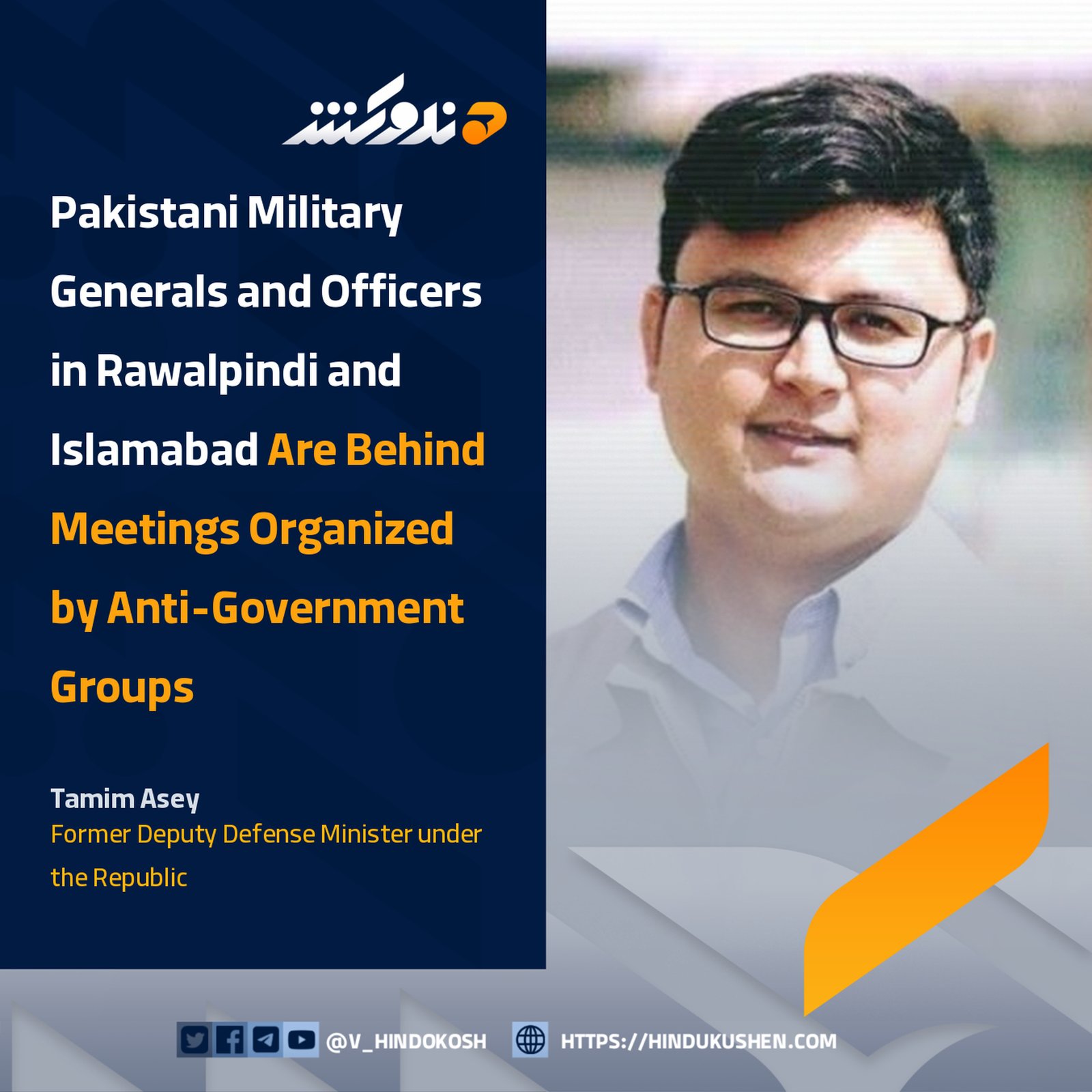
Tamim Asey, former deputy defense minister under the former Republic, has accused Pakistan and its intelligence agency, the ISI, of using certain Afghan figures to organize meetings in Islamabad and Madrid as part of an effort to exert international pressure on the Afghan government. He said the meetings were not genuinely aimed at defending women’s rights but were intended to advance Pakistan’s strategic interests.
Asey stressed that Pakistan had never supported Afghan women’s rights and continues to use the issue as a tool of foreign policy to pressure the Afghan government.
He said Pakistani generals were seeking to control rare mineral resources on both sides of the so-called Durand Line. He added that Pakistan’s recent activities involving Chitral and Badakhshan, including movements across the region, contacts with certain individuals, efforts to recruit them, and the provision of visas and residency facilities, should be viewed in this context.
Asey identified Pakistani military generals and officers based in Rawalpindi and Islamabad as the main architects behind the meetings organized by anti-government groups.
Describing the gatherings as a “washing machine for the garbage of the Republic,” he said some individuals involved in various forms of corruption in the past are now presenting themselves in Madrid, Islamabad, and London as human rights activists, women’s rights advocates, and campaigners.
He added that some participants knowingly become part of foreign agendas, while others are unaware of the role they are playing. Others, he said, attend simply to pass the time.
Asey also dismissed Spain’s role in Afghanistan-related affairs, describing its involvement as largely media-driven and disconnected from the country’s core foreign policy.
He argued that these meetings instead strengthen the Afghan government’s legitimacy, as people with conflicting positions and different backgrounds, who have no clear common objective, are brought together solely by Pakistan and its intelligence agency.
Asey concluded by describing the gatherings as a “dirty, multifaceted game” aimed at destroying Afghanistan.