




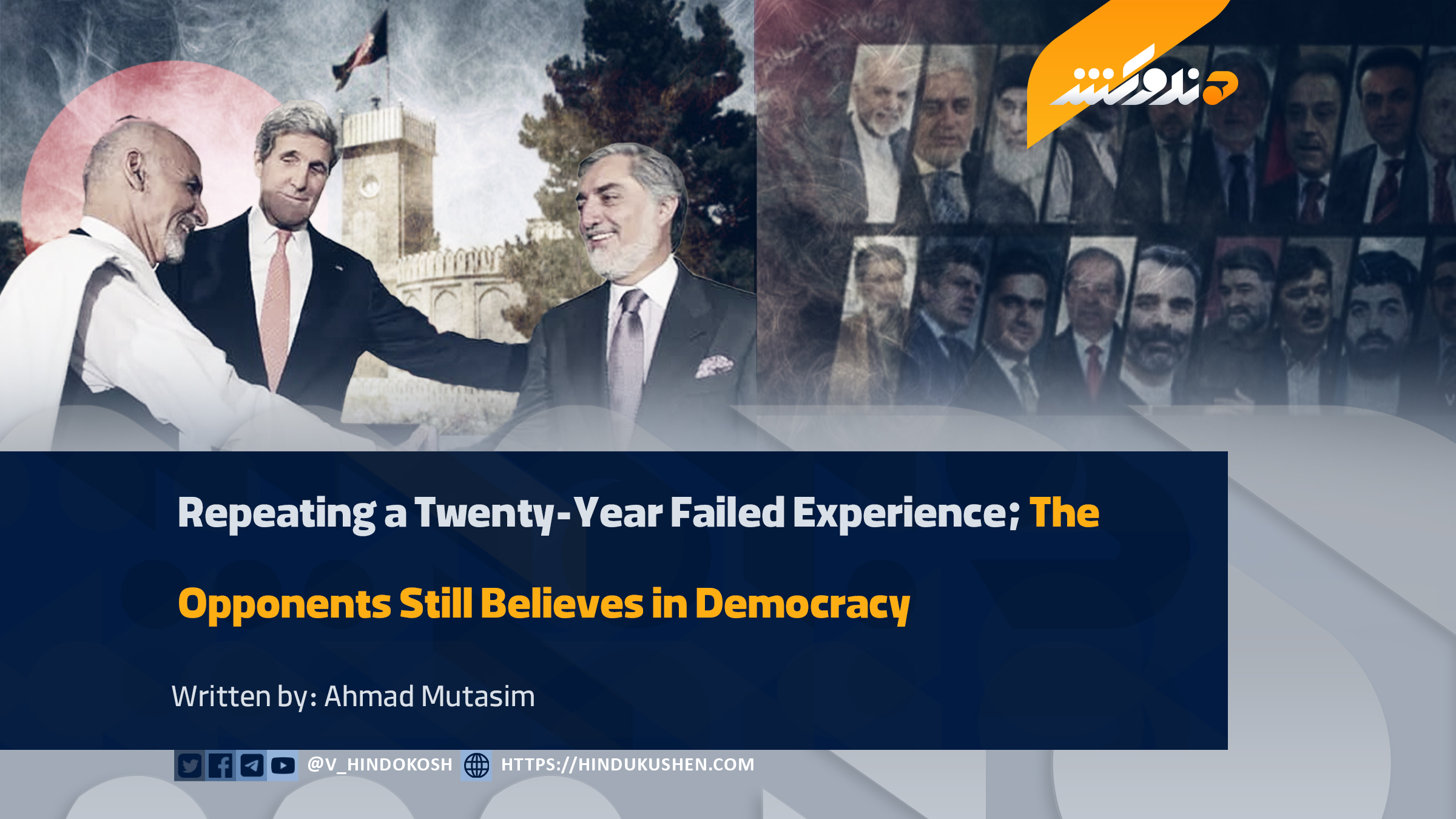
Written by: Ahmad Mutasim
The former Minister of Refugees of the fallen republican regime, Noor Rahman Akhlaqi, who himself was part of the high executive and political circles of the twenty-year republican regime, has considered democracy the only way out of Afghanistan’s current crisis. This stance has been presented at a time when the evaluation of the twenty-year implementation of democracy has been left aside, and now he is trying to convince the people again with the same old version, as if it is the solution to all of Afghanistan’s crises and problems.
In Afghanistan, democracy has been tested for twenty years not just as a theoretical commitment but as an experiment by the occupiers and local authorities. This experience took place under the shadow of war, foreign presence, billions of dollars, elections, a constitution, a parliament, and hundreds of civil institutions, but the outcome was neither justice, nor balanced power, nor public welfare, nor a reliable solution to all crises. Therefore, the claim that the only way out of the crisis is “unconditional democracy” fundamentally contradicts the historical and practical reality of Afghanistan.
Democracy, as it was implemented in Afghanistan, was far from human and ethical lines. Elections were not a representation of the people’s will, but rather a spectacle of force, money, tribal deals, and foreign interests. Power was exchanged hand in hand between a few limited political networks instead of being balanced, justice was selective, and the law was lenient for the powerful but harshly enforced for ordinary people. If democracy is a framework, then this framework has proven to be a machine for producing corruption, injustice, and social inequality in Afghanistan, not a means to solve the crises born from the warlords’ crimes.
These defenders of democracy often justify the problem under the title of “imperfect implementation,” but this justification is itself a form of shirking responsibility, because twenty years of power, vast resources, and unprecedented international support were not shortcomings but rather complete opportunities that these pro-democracy officials had the power to utilize. The main problem was that democracy was imposed in Afghanistan not based on social reality, historical memory, and human needs, but as an imported formula, by force.
It is a fact that the new Afghan government fundamentally rejects Western democracy by implementing Sharia, as it considers democracy a foreign concept. However, blaming this government for Afghanistan’s political collapse is far from reality. The political movements that consider themselves defenders of democracy were unable to solve the crises during their time in power. Their internal structures, leaders, decisions, and political behaviors were filled with power-seeking, monopoly, and self-centeredness; this contradiction eroded people’s trust not only in democracy but also in the entire political structure of the republican regime.
The root of today’s public distrust is not in the new Afghan government, but in the twenty-year regime that, under the guise of people’s votes, traded the dignity, security, and future of the people. Democracy had become a mechanism for the distribution of power among political elites and members of a joint-stock company under the rule of the republic. Therefore, the discussion about Afghanistan’s future should start with honest accountability rather than slogans; if not, democracy or other foreign formulas will only pave the way for another failure.
Note: The articles, essays, and comments published by the Voice of Hindukush only reflect the views of the authors & writers and do not necessarily represent the agreement of the Voice of Hindukush.