




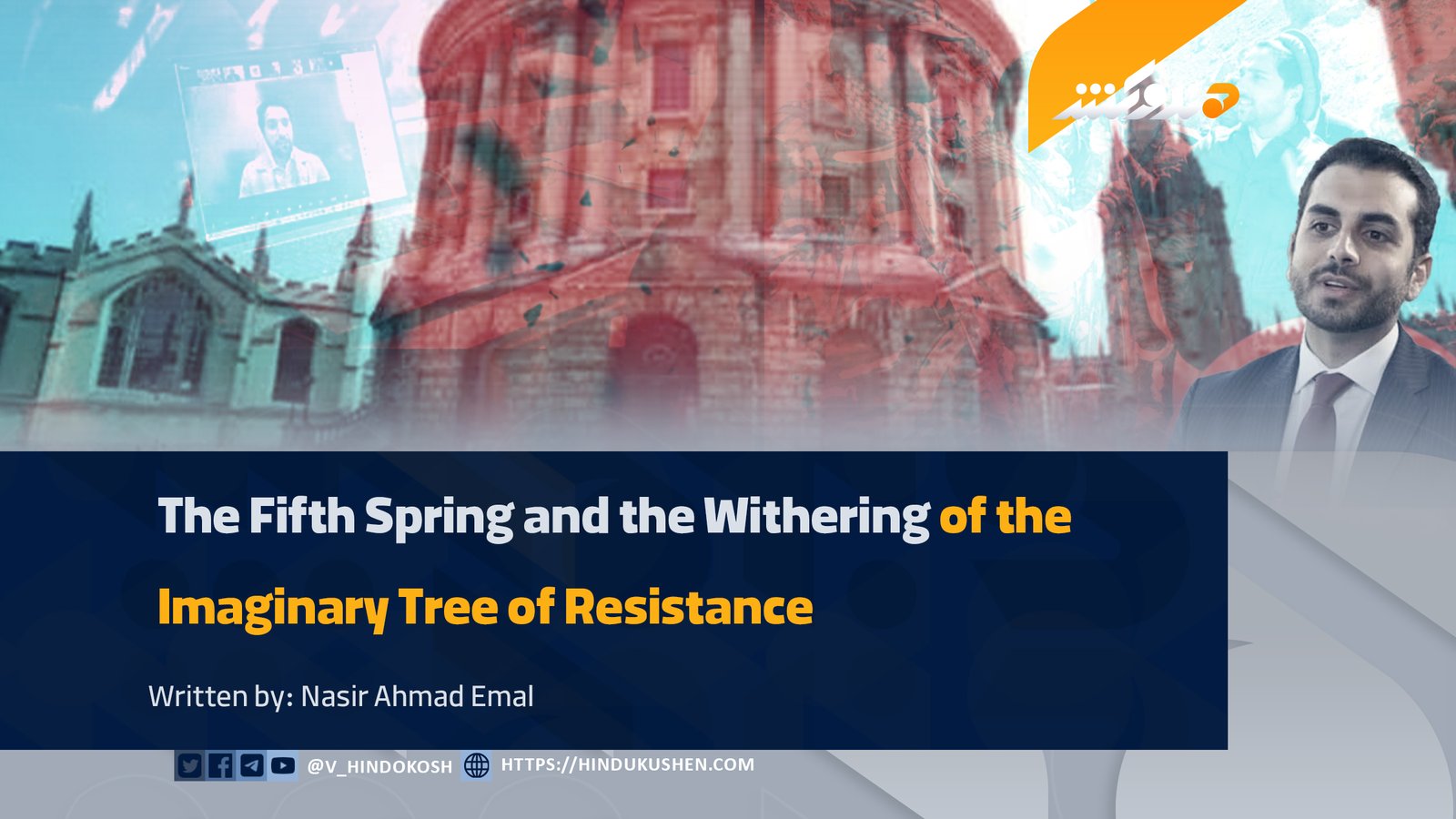
Written by: Nasir Ahmad Emal
Nearly five years ago, when the story of the fall of the republican regime was not yet complete, several defeated politicians on the battlefield introduced a new political and intelligence project under the name of Resistance to the people, promising an alternative, salvation, and a future. At that time, their propaganda accounts depicted a scenario where Afghanistan would soon witness a broad resistance, fronts would unite, international support would be garnered, and the power equation in the country would change. But now that the fifth spring is passing, neither did the promised tree bear fruit nor did it provide shade; rather, the imaginary tree of resistance is withering day by day.
The latest example is a meeting at the University of Oxford in Britain, which was held about the last four years and the future of Afghanistan. The head of foreign relations for the Resistance Front, Maisam Nazari, attended in person, and Ahmad Massoud gave an online speech. Massoud repeated his usual statements, and his supporters deemed the meeting productive and meaningful.
Instead of a physical presence, they demonstrate their political weight in seminars at hotels, institutes, and universities. They do not want to be named at all, occasionally showing their presence in ordinary and informal places. It seems as if, instead of the battlefield of Afghanistan, they have made the stages of conferences the standard for proving their resistance. These low standards show how weak and incapable this group is.
The intelligence agencies of the world, or generally countries, rely on those groups that either have popular roots, an organized political structure, or the ability to bring about change in the field. Simply speaking in Oxford, Washington, or European halls, issuing warnings, and accompanying them with clichéd slogans does not change the power equation. This is why people are left wondering: if five years later the greatest achievement of the resistance is still a seminar, an online speech, and a few photos, then where are the signs of its claimed influence?
Another important fact is that the Resistance group did not even maintain its claim of unity. The group that considered itself the common home of all opposing fronts has become the most affected by fragmentation. Hamid Sifi’s separation is not just a personal disagreement; rather, it is a turmoil that is spilling out from within. It is a major conflict over power, a void left by a wise leader, which is gradually emerging and becoming apparent, dismantling the structure of resistance. When a movement is already plagued by competition, distrust, and division among its members before even attaining power, its future can be predicted to be doomed.
The propaganda of the resistance group no longer stirs the people’s emotions. Because the people see the gap between slogans and reality with their own eyes. People see that every year new meetings are held, new statements and interviews are published, but the same old ineffectiveness prevails in the field of action. This is the fifth spring passing and heading toward its end, but the resistance group faces a serious threat of extinction with each passing day.
Note: The articles, essays, and comments published by the Voice of Hindukush only reflect the views of the authors & writers and do not necessarily represent the agreement of the Voice of Hindukush.