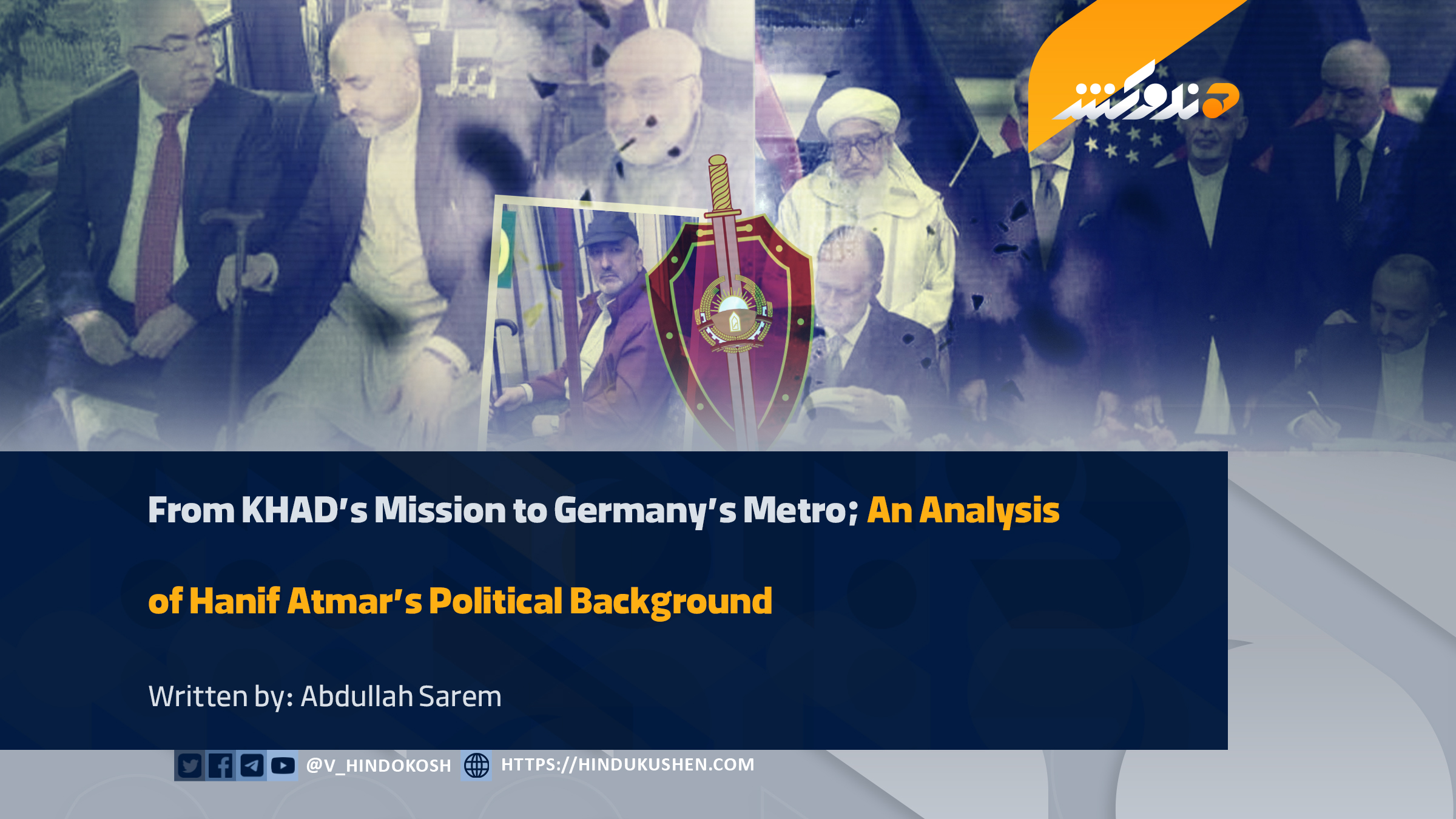
After an image of Hanif Atmar went viral on media, showing him in a public city metro among ordinary people, a wave of responses and discussions about his name and political background erupted on social media.
Some saw this image as a sign of his simplicity, purity, and humility, and relying on this appearance, they sought to cleanse his political past; a past filled with key positions and involvement in the country’s most important political developments and transactions.
In contrast, another group saw Atmar’s appearance in the metro not as a sign of simplicity, but as a symbol of humiliation and disgrace, which they believed was the natural consequence of a record filled with betrayal, alignment with the occupiers, and trading away the land and values of this country.
But the reality is that political figures should be recognized and judged not by a single image or a dramatic gesture, but by their political record – a record that reflects their historical decisions, stances, and responsibilities.
If the pages of Hanif Atmar’s political life are turned, it is clear that from the first day he entered the political arena until recent years, he has always been at the heart of power and held sensitive and key positions; a presence that has undoubtedly been influential in the political, cultural, and security destiny of Afghanistan.
Atmar served as an official member of the intelligence structure “KHAD” during the Soviet Red Army’s occupation of Afghanistan. The role of this agency in suppressing, pursuing, and capturing the Mujahideen fighting against the Soviet occupation is well-known. He was effectively in the ranks of the forces that stood against the people who had risen up to defend their land, religion, honor, and freedom.
According to available accounts and information, Atmar was wounded in one of the direct clashes with the Mujahideen during the Soviet occupation, an injury that is said to have left its mark on his body to this day. This fact, regardless of its details, shows that he was not an impartial observer but an active player on the opposite side of the Afghan people’s jihad.
After the fall of the communist regime and years later, with the American invasion of Afghanistan, Hanif Atmar once again stood alongside the occupiers and, for the second time, chose the path of alignment with foreign forces. In the puppet government of the Republic, he held important and decisive positions and played a role in the power structure.
During his rule as Minister of Education, the country’s education system underwent changes that marginalized the culture and content of Islamic education in an unprecedented and dangerous manner, paving the way for the dominance of Western models and values in the curriculum; an action whose consequences, despite the standardization of the education system based on Islamic values, remain with some to this day.
Another betrayal by Atmar reached its peak during his rule as National Security Advisor under Ashraf Ghani presidency, a period that saw the signing of the security agreement with the United States, one of the most sensitive and controversial decisions in the contemporary history of Afghanistan. The agreement under which the presence of permanent US bases on Afghan soil was signed by these same traitors, and which at that time gave the occupying forces free rein for military operations, bombing, and the killing of civilians.
Atmer not only did not remain silent about this treaty, but was also one of the figures who openly defended it and campaigned for its signing.
With such a track record, how can someone whose political past is intertwined with collaborating with occupiers, standing against the Mujahideen, bargaining over the country’s independence, and disregarding the religious and national values of the people be purified and praised simply by sitting in a metro? Which of his backgrounds should we talk about? From a background in intelligence work serving the Soviet Union? Or from a history of aligning with America and legitimizing its military presence in Afghanistan?
Sitting in the metro, for someone who, for the sake of fame, position, and personal gain, has repeatedly aligned their path with the occupiers and put the fate of a nation on the negotiating table, is neither a symbol of simplicity nor a sign of being people-oriented; rather, in the eyes of critics, it is a symbol of humiliation, disgrace, and political shame.
Note: The articles, essays, and comments published by the Voice of Hindukush only reflect the views of the authors & writers and do not necessarily represent the agreement of the Voice of Hindukush.