




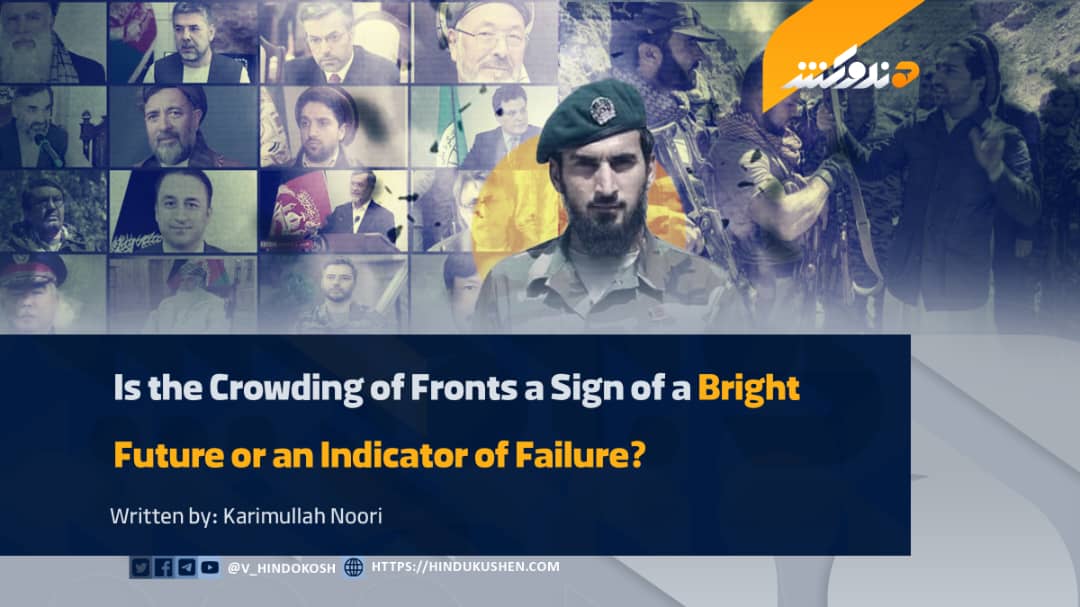
Written by: Karimullah Noori
After the fall of the Republic in Afghanistan, those who were in power and had actually engaged in the division and fragmentation of the people and the country, whose hands were stained with murders, thefts, and widespread corruption, instead of shamefully withdrawing from the scene and accounting for their past actions, began forming new parties and fronts.
But these efforts have the same old and useless color from the beginning; there is neither change nor reform in them. They haven’t done anything practically yet, but their end has already begun. These groups immediately became embroiled in splits and divisions upon their formation, and their disputes over personal interests have reached a peak; interestingly, all their problems are at the level of their leaders. Here, the Pashto proverb applies well: a crooked load does not reach its destination.
From the very beginning, as movements under the names of Resistance and Alternative emerged from the remnants of the Republic, a unified axis was not formed; each group, each commander, and each political figure chose a separate path for themselves. This situation was not such that unity existed first and then a split occurred, but rather this very formation was based on division.
Disputes over leadership, competition for influence, and clashes of personal interests emerged so quickly that the foundation stone had not yet been laid, but cracks were already visible. The result was that parallel fronts emerged, small groups separated from the larger ones, and each considered itself the representative of the main path; but in reality, this entire process is the result of weakened unity and childish politics. Further divisions from the existing split are like holes in a vessel, which will eventually sink the entire vessel.
Hamid Sifi, who was one of the commanders of the Resistance Front, had presence on the battlefield in many battles. But now, like other resistance fighters, he has fled the country and has distanced himself from Ahmad Massoud. He opened a new front under the name of the Freedom and Justice Movement and has separate goals.
Although Hamid Sifi has not revealed the reasons for this split, common belief and public opinion suggest that the causes include the family monopoly in Ahmad Massoud’s decisions, the misuse of the front’s funds for personal trips, financial corruption by the head of foreign relations and other members, the waste of hundreds of thousands of dollars in aid from certain intelligence organizations, decisions about money being made solely by Ahmad Massoud’s uncle and maternal uncle, targeting their own comrades due to ideological differences, neglecting the families of fallen fighters, and the leadership circle adopting ethnic and sectarian characteristics.
Those fronts and groups that still lack internal cohesion and organized structure, their claims of grand objectives are far from the existing reality. Because any political or military movement that has issues of unity, trust, and organized leadership within its structure cannot achieve the necessary stability and capacity to realize great goals. In such a situation, all claims are merely slogans and keeping the media pages warm, and the competition between groups may escalate from verbal disputes and divisions to actual clashes; we saw that Akmal Amir, Dawood, and other similar individuals were killed in the turmoil of their internal conspiracies.
When trust, discipline, and legitimate leadership are lost within a movement, internal enemies prove to be more deadly than external ones. After this, the movements will further disintegrate, and in the greed for positions, money, or leadership, they will slowly shed each other’s blood.
Note: The articles, essays, and comments published by the Voice of Hindukush only reflect the views of the authors & writers and do not necessarily represent the agreement of the Voice of Hindukush.