




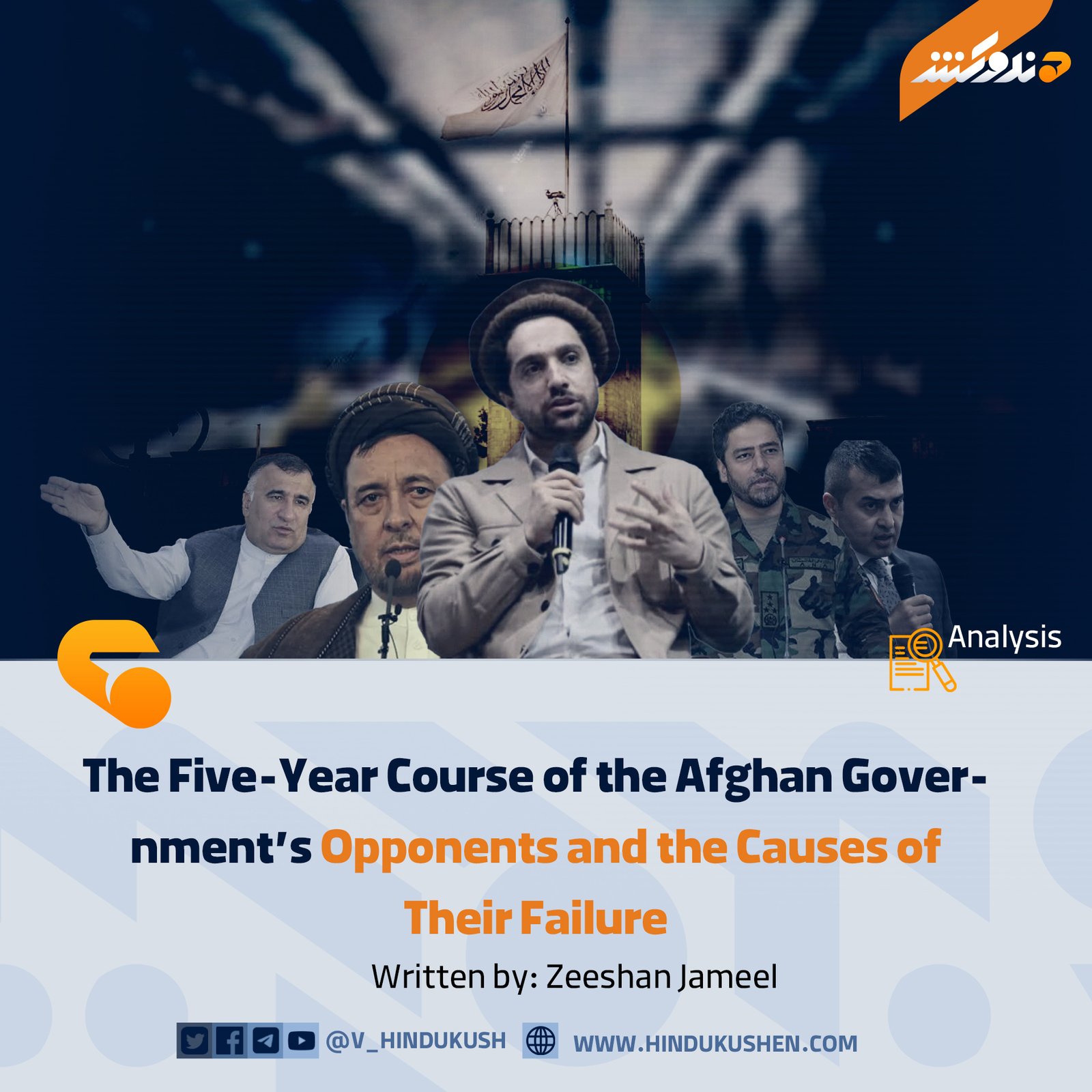
Analysis
Written by: Zeeshan Jameel
Introduction
On the 24th of Asad, 1400 AH, the republican regime of Afghanistan collapsed, and a new system took over the country. Five years have passed since the establishment of the new government, and during these five years, Afghanistan has undergone profound and decisive transformations in every aspect. After the establishment of the new regime in Afghanistan, one of the initial questions was whether various opponents and political figures would be able to rise against the new government as a strong, cohesive, and organized force or not. But as time passed and the concrete evidence of the past five years showed, the government’s opponents not only failed to reach a stage of effective resistance, but also became entangled in a series of problems over the past five years that accelerated their political decline.
The five-year situation of these opponents shows that, in the absence of cohesion, a clear vision, and strategic thinking, all their efforts have remained limited to reactions, statements, and online meetings. The various political groups, councils, and non-governmental fronts formed in exile were unable to respond positively to the fundamental demands of the Afghan people (security, stability, and unity) or present a practical plan for progress. On the contrary, internal conflicts over power, the absence of an Islamic and national vision, and a detachment from global realities led them to squander all their potential opportunities.
In this analysis, the past five-year situation of the Afghan government’s opponents has been examined; the opponents have failed due to the absence of a stable ideology, deep internal conflicts, lack of an alternative program, overt foreign dependence, organizational chaos, and complete disconnection from the people. They have been expelled from foreign and regional stages and have reached a phase of total political isolation.
The Absence of a Stable Ideology and Intellectual Identity
The fundamental pillar of success for any movement or political party is based on a clear, coherent, and consistent ideology and intellectual framework. But the primary and greatest weakness of the Afghan government’s opponents is the lack of a clear ideological and theoretical school. They fundamentally lack an ideological reference that can unite their supporters and the people under a clear goal.
Due to the absence of ideology and the unclear political framework, severe contradictions are observed in the opponents’ statements and stances. Some shout for Western liberal democratic values, others want to restore the previous corrupt republican regime, another group raises the banner of federalism and secession, and yet others refer to the country’s traditional and ethnic structures. This deep ideological division and lack of stability have caused not only their followers to be perplexed but also ordinary citizens to lose faith in their identity and ideals.
The lack of coherent thought has led the entire opposition to a state of emotional and reactive behavior. They have never produced a theory based on their ideological exchanges and foundations, but have always issued statements based on the Afghan government’s daily actions, laws, and new decisions. This ideological gap shows that the opponents do not possess a sustainable political thought and, as a result, lose their attractive power over the long term, and they have already lost much of it.
Similarly, the absence of a clear ideology has hindered the recruitment of cadres, intellectuals, and aware members of society among the opponents. The aware members of society are reluctant to join such processes, as they themselves are bewildered and confused in interpreting and defining their own policies. The opponents do not have a stable ideological foundation, which has led all their meetings and statements to be reduced to temporary political activities and gatherings.
Internal Conflicts and the Leadership Crisis
After the ideological vacuum, the second deep crisis that has shattered the opponents is their internal conflicts and the absolute lack of strong and accepted leadership. In the past five years, it has been proven that various factions and different exiled political figures, parties, councils, and circles are not even capable of minimal agreement and coordination among themselves to unite under a single leadership. The leader of each small group considers himself superior to all opponents and is not prepared to form a real alliance with other so-called fronts.
The destructive rivalry between them is not centered around the higher interests of the country and the people, but rather on personal ambitions, past political rivalries, and group interests. Whenever an individual conference or meeting is held abroad, more attention is paid to how aggressively the leader of a particular group spoke, rather than the social objective. For them, it is an embarrassing situation, as they have demeaned themselves more than the public and the world.
Similarly, the deep-seated prejudices and organizational grudges between these groups have reached a point where, in many cases, one group is pleased with the failure of the other group. This internal conflict and verbal attacks on each other thru social media prove that in their statements and declarations, the word “unity” is mentioned only in words, but in reality, they are deeply immersed in animosity and disputes over power-sharing more than anyone else.
On the other hand, the lack of clear leadership also eliminates the chance to establish an accepted framework. In the past five years, the efforts of some countries and intelligence agencies to bring them together have also been unsuccessful. This fragmentation has prevented the opponents from rising up as a united front. It does not rise up, but rather transforms into numerous factions, each attempting to deny, destroy, and split from the others.
Lack of a Strategic Plan and Proposal:
If we delve deeper into the factors of the opponents’ ineptitude and failure, we can say that they lack a program, plan, and strategic vision. The opponents have made several attempts to hold meetings under the pretext of presenting an alternative or determining Afghanistan’s future, but these meetings were so exclusive that only two or three groups from among the opponents participated. However, instead of announcing a plan, reports of deep disagreements over minor issues emerged from within the meetings.
In the past five years, the opponents of the Afghan government have not presented a comprehensive and unified plan to either the Afghan nation or the international community, not even the size of a single page. This is because within one group, there were not even two people with the same opinion, let alone between different groups. Due to these disagreements, many members of the groups have separated from their groups, and the groups are on the brink of fragmentation.
There is no scientific plan or proposal from the opponents regarding governance, economic development, infrastructure construction, domestic and foreign policy, and other fundamental issues. All the opponent’s speeches are limited to criticism and reactions. But the truth is that politics cannot progress solely thru criticism; it seriously needs scientific and practical approaches.
Moreover, the opponents are unaware of Afghanistan’s new economic and social reality. While the Afghan government is working on major national projects such as the Qosh Tapa Canal, TAPI, railroads, and the reconstruction of many major roads, the opponents do not recognize these changes. In their conferences, meetings, gatherings, and writings, instead of mentioning such economic and developmental issues, they just repeat political lies and slogans!
The lack of an alternative plan from the opponents has been proven, as even if their demands are accepted, there is no mechanism for managing and organizing society. This lack of planning has caused the public to turn their attention away, because people want long-term and fundamental programs to ensure a better future, which the opponents does not have in mind.
Reliance on Foreigners and Misunderstanding of Realities:
Another major mistake in the new international relations, which led to the downfall of the opponents, was the blatant and absolute reliance on foreign sources and the misunderstanding of geopolitical realities. From the very beginning, instead of building genuine connections within the country and with their own people, the government’s opponents were waiting for foreign political representatives, foreign intelligence organizations, and some Western senators.
Their strategic mistake led them to be recognized by the public as “implementers of foreign projects.” The opponents believed that by holding meetings in the luxurious hotels of foreign countries, they could determine Afghanistan’s fate. However, the people of Afghanistan have repeatedly proven that movements with foreign characteristics and foreign funding can never gain their sympathy and approval.
In addition, the strategic influence and attention of foreign countries have also rapidly changed in the past five years. Foreign powers have changed their priorities in light of the world’s new geopolitical realities (such as the Ukraine war, Middle Eastern crises, and economic competitions). Funding the previously experienced and failed figures no longer brings any benefit to these powers.
The process of international lobbying by the opponents has also completely failed. The opponents were unable to present evidence and logical arguments to attract the attention of international powers. The result was that foreign financiers and intelligence agencies turned their backs on them one after another, leaving them defenseless.
Diplomatic Isolation:
Along with the loss of foreign support, the expulsion of opponents from international and regional stages and diplomatic arenas is another significant evidence pointing to their complete isolation, which can also be considered one of the factors of their defeat. If in the early days, meetings, conferences, and gatherings were held for them in various neutral or enemy countries, over the years, these invitations have dwindled to nearly zero, and now there is only a place for them to gather where they are used in a selective manner as proxy mercenaries.
In the past five years, important and influential countries in the region, such as Russia, Iran, Central Asian countries, Gulf states, and even some European countries, have well understood that engaging with the opponents has no logical basis and does not benefit Afghanistan’s stability. For this reason, these countries focused all their diplomatic efforts and interactions on the new Afghan government and sidelined the opposing groups.
Perhaps the failure of the various demands of the opponents to be addressed in the symbolic meetings of Western countries and the United Nations has shown them that opposition is not just about meetings, gatherings, criticisms, slogans, and false claims, but rather that their cause is just, the nature of their opposition is legitimate, and it has an executive and enforceable impact in Afghan society. This state of the opposition can be considered the biggest defeat of their diplomatic process.
In the past five years, the expulsion of opponents from the stage reached a point where many countries even imposed explicit bans on the opening of their simple offices and political activities. This reality proved that the world no longer believes in the slogans and empty promises of the Afghan government’s opponents and accepts the facts as they are.
Organizational Chaos:
In the past five years, another dangerous reason for the opposition’s failure has been the fundamental fragmentation, disorder, and parallel so-called structures within the opposition groups. Their organizations are not based on a structured party and organizational framework, but rather divided into dozens of small paper councils, so-called fronts, ethnic and regional groups, which only have names on social networks and Facebook pages and occasionally claim a false attack by two or more groups instead of one.
This organizational chaos also has various factors, such as the imposition of leadership by old warlords, notorious and dark figures, the absence of young cadres among the opposition, conflicts over limited financial resources, managerial ignorance, and the formation of groups based on familial ties, which can be cited as examples.
This chaos has limited the opponents’ work to mere imagination, futile campaigns on social media, discussions, and Zoom conferences. Opponents must understand that focusing on the virtual space and spreading misinformation about the situation in Afghanistan from afar will never lead them to victory. Just as they faced clear failure in the past five years, their future will also be wasted in the same way.
Separation from the land, society, and people
Social disconnection and the distance of the opposition from the land and the people, along with their ignorance, are significant drivers and causes of their failure. Just as the opposition has distanced itself from the people, the land, and society in the past five years, they have also become unaware of realities, situations, and everything else. A significant gap of distrust has emerged between the general public and the opposition.
What the people want, the opponents stand against, because they are distant from the people, the land, and the society, and this distance has caused the opponents to ignore the people’s demands. The natural consequence of this action is that the opposition will not benefit from popular support in five years, or even in decades.
The current demand of Afghan society is the establishment of Sharia law, independence, territorial integrity, self-sufficiency, the protection of values, and prosperity, not proxy wars, destruction, the trampling of values, and the loss of independence; which elevate the country from the heights of prosperity and plunge it into the depths of decline.
Conclusion
Based on the aforementioned dimensions, it can be said that the past five-year journey of the Afghan government’s opponents is an example of their decline. The lack of thot and ideology, internal conflicts, the absence of practical and constructive strategies, reliance on foreign intelligence organizations and countries, exclusion from international and regional arenas, and the alienation from society, land, and people are the factors that have led the opponents to political defeat in the past five years.
The opponents have proven over the past five years that they do not have the capacity to solve the complex problems of current Afghanistan, and their series of meetings, conferences, and statements are merely a maintained process for a purposeless political presence. The Afghan society currently has diverse demands, demands that if the opponents accept, they will no longer remain a group or faction under any name and will distance themselves from the political arena.
In the past five years, the opposition has taken rapid steps toward defeat, and in the future, their remaining steps toward failure and disappearance will be even quicker. This is because with each passing day, the situation in Afghanistan and the world changes; Afghanistan is moving toward stability, and the world, which the opposition has relied on for support, has quickly turned its attention away from them and has become involved in other global issues.
Note: The articles, essays, and comments published by the Voice of Hindukush only reflect the views of the authors & writers and do not necessarily represent the agreement of the Voice of Hindukush.