




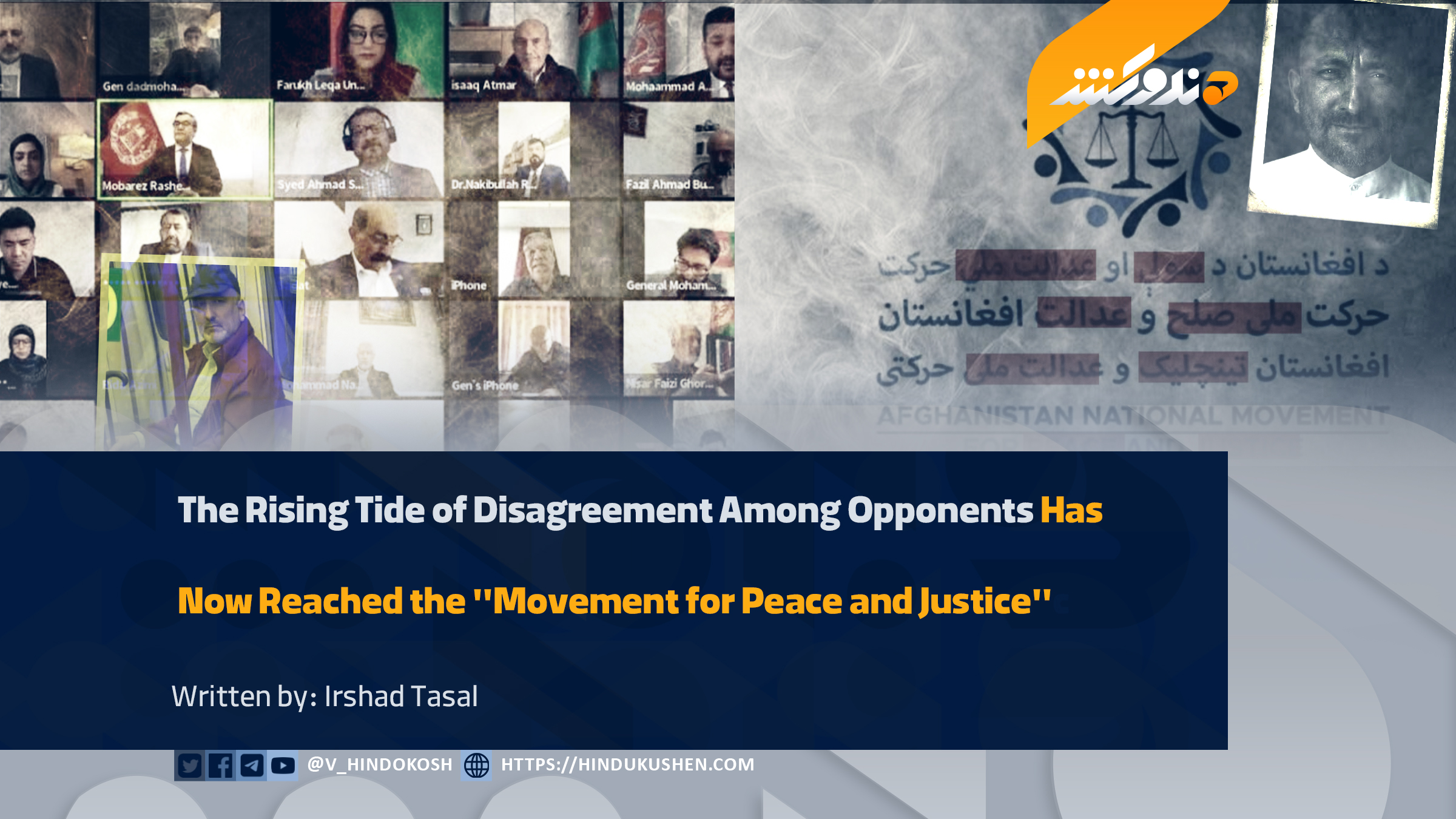
Written by: Irshad Tasal
In recent years, the most significant specificity of the Afghan government’s opponents was not only the loss of power but also their internal distrust, political fragmentation, and the absence of a unified narrative. This situation started with military fronts and gradually extended to political movements and parties, to the point that recently, the “Movement for Peace and Justice” led by Hanif Atmar has also fallen victim to the same crisis.
The atmosphere of distrust among the political opponents of the Afghan government is not the result of a single day or incident, but rather the outcome of years of failed experiences, incomplete alliances, and the absence of a common goal. Each group presents itself as an alternative, but their definition of an alternative is not only different but sometimes contradictory, which has reduced the possibility of political coordination.
In the military phase, the conflicts were largely over resources, command, and foreign support, to the extent that they escalated to physical elimination and continued to this day. But when the disagreements reached the political arena, they became deeper and more sensitive because political legitimacy requires a more delicate foundation than weapons. Therefore, the cracks that were previously hidden have now become apparent in statements and the media.
The issue of trust among the old warring factions like the Wahdat Party, Junbish, Resistance, and others has not yet been resolved; rather, it has worsened, and their members are increasingly distancing themselves from each other every day. Each party and group tries to maintain its historical weight, but it can not create a common framework for the new political reality.
Generally, the rivalry among the opponents of the Afghan government is largely personal. When politics revolves around individuals, disagreements become personal, and their resolution is perpetually difficult, as ordinary differences escalate into more conflicts. Similarly, the ambiguous stance of international players is also a source of distrust; each group tries to prove itself deserving of potential support, which further deteriorates internal relations. In such an atmosphere, it is very difficult to form a united stance.
The Movement for Peace and Justice, initiated by Haneef Atmar, was initially perceived by some factions as potentially offering a moderate, rational, and technical alternative within the fragmented political landscape of Afghan society. However, over time, it became clear that this movement is also grappling with the same issues that other opposing factions are entangled in.
Based on this, the Movement for Peace and Justice can not fill the gap of trust solely by relying on its name, statements, and past political weight. This movement has not been able to present an independent, clear, and actionable path, nor has it created any practical framework to resolve the deep-seated differences it itself faces. Therefore, the logical conclusion is that such structures reflect the continuation of political confusion instead of an alternative; as long as fundamental change, a clear vision, and real accountability are absent, skepticism and rejection of such movements are considered a natural and reasonable stance, ultimately leading to a split due to internal differences.
Note: The articles, essays, and comments published by the Voice of Hindukush only reflect the views of the authors & writers and do not necessarily represent the agreement of the Voice of Hindukush.