




Written by: Wahid Ibrahimi
The philosophy behind creating political parties may be based on supporting the people and defending their basic rights in other countries, but in Afghanistan, during the dark period of civil wars and then in the twenty years of the republic, these parties were not created to support the people, but to legitimize the crimes of specific individuals; those who were at the head of these parties and called themselves the leaders of the suffering people of Afghanistan.
Accordingly, there were countless parties and movements during the Republic, movements that typically carried suffixes like “Islamic” and “National” to provide better cover for their crimes and atrocities.
One of these notorious parties with a long history in devastating civil wars was the Junbish party led by Abdul Rashid Dostum, a movement created in 1371 Hijri Shamsi after Dostum’s transformation from a communist and Soviet hireling into a patriot and collaborator with jihadist groups.
Although all existing parties and movements that brought nothing but evil and harm to this nation were declared dissolved after the new government came to power in Afghanistan, disgraced figures of the collapsed republic outside of Afghanistan claimed the continued activity of these parties; parties that, although they had no popular base even during the republic, are now not even the small number of people seen around them.
It is worth mentioning that the endless disputes among the self-proclaimed leaders of these parties continue even after their humiliating escape from Afghanistan. More than four years later, not only have these parties failed to unite, but the process of internal splits within the parties has also begun.
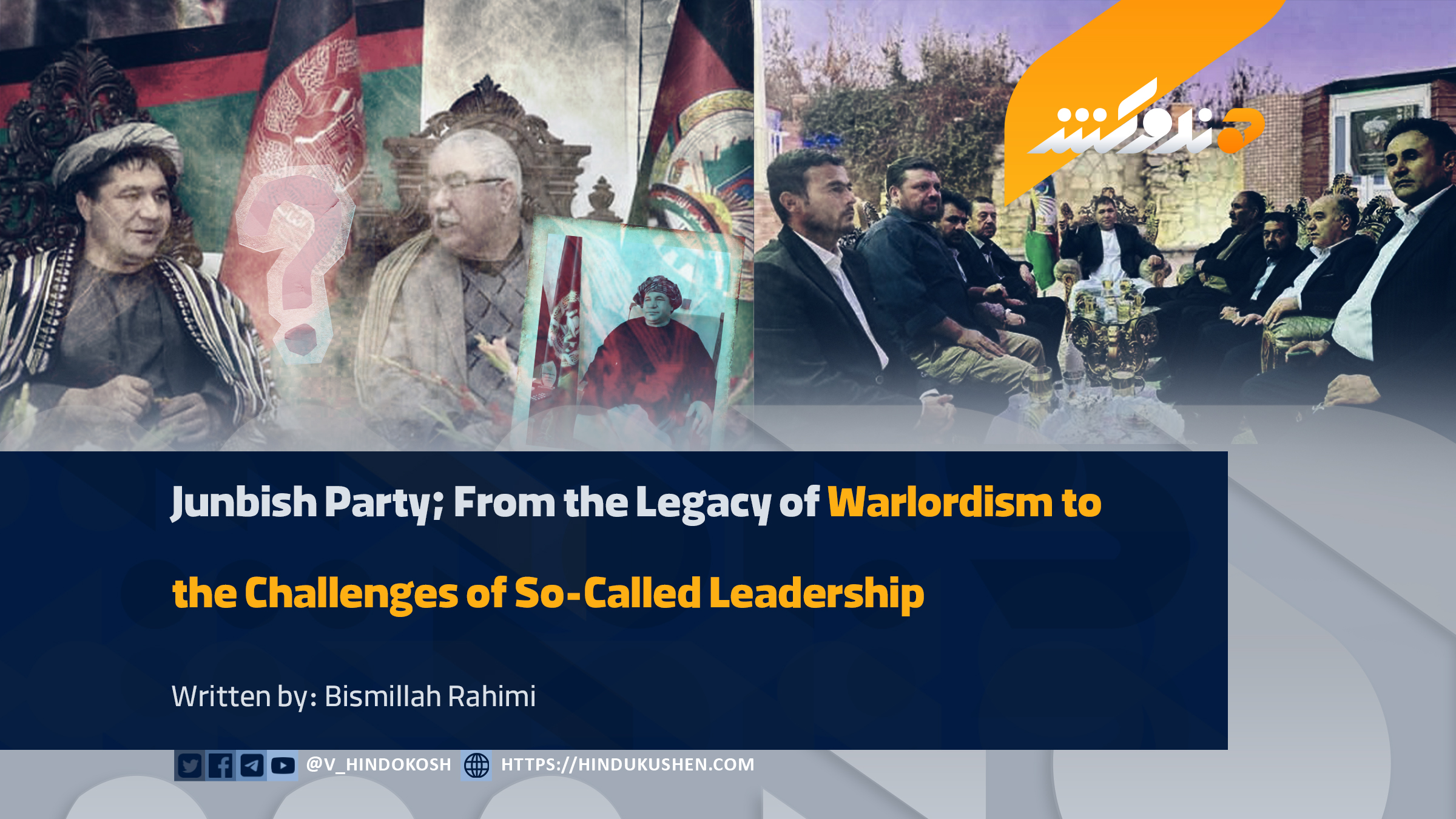
After the Jamiat party and the Resistance Front, it seems it is now the turn of the Junbish party to experience internal division. Although Nizamuddin Qaisari declared himself the leader of the Junbish party some time ago and stood against Dostum, videos have recently been released showing a number of defectors alongside Qaisari. After praising and describing Qaisari, they call him the leader of the Junbish group by placing a chapan on his shoulders.
This video gained attention because Qaisari was praised by several figures seemingly associated with the Junbish group and was designated as the leader of the movement. This clearly revealed a major division within the Junbish party and showed that the few who still consider themselves part of the movement no longer believe in Dostum’s leadership and do not want to be under his command.
The appointment of Nizamuddin Qaisari as the leader of the Junbish Party by a number of Afghan refugees in Iran once again revealed that parties that were once formed with the claim of representing the people and defending their rights have today become empty names and arenas for personal competition.
This appointment, although superficially considered a leadership change, is at its core a clear sign of the collapse of legitimacy and a deep rift within a party structure that had long been sidelined from the real political scene in Afghanistan.
These staged events reveal more about the controversy surrounding an imaginary party than about its revival; a party that has been absent from the political arena for four years and is not mentioned in serious meetings.
Abdul Rashid Dostum’s silence in the face of these claims has only added to the ambiguity and deepened the rift, showing that even among the few who still consider themselves affiliated with the movement, consensus and trust have not remained.
In conclusion, it must be said that what is seen today in the form of leader selection, internal disputes, and media displays within the Junbish Party does not represent a new political development nor does it create greater importance for this party than in the past. Rather, it is merely a continuation of the same worn-out and discredited state of parties built on individuals and personal interests.
The current fate of the Junbish party also shows that movements that lack popular support and genuine legitimacy from the outset inevitably lead to division, splits, and reduction to ineffective names on the margins of Afghan politics.
Note: The articles, essays, and comments published by the Voice of Hindukush only reflect the views of the authors & writers and do not necessarily represent the agreement of the Voice of Hindukush.