




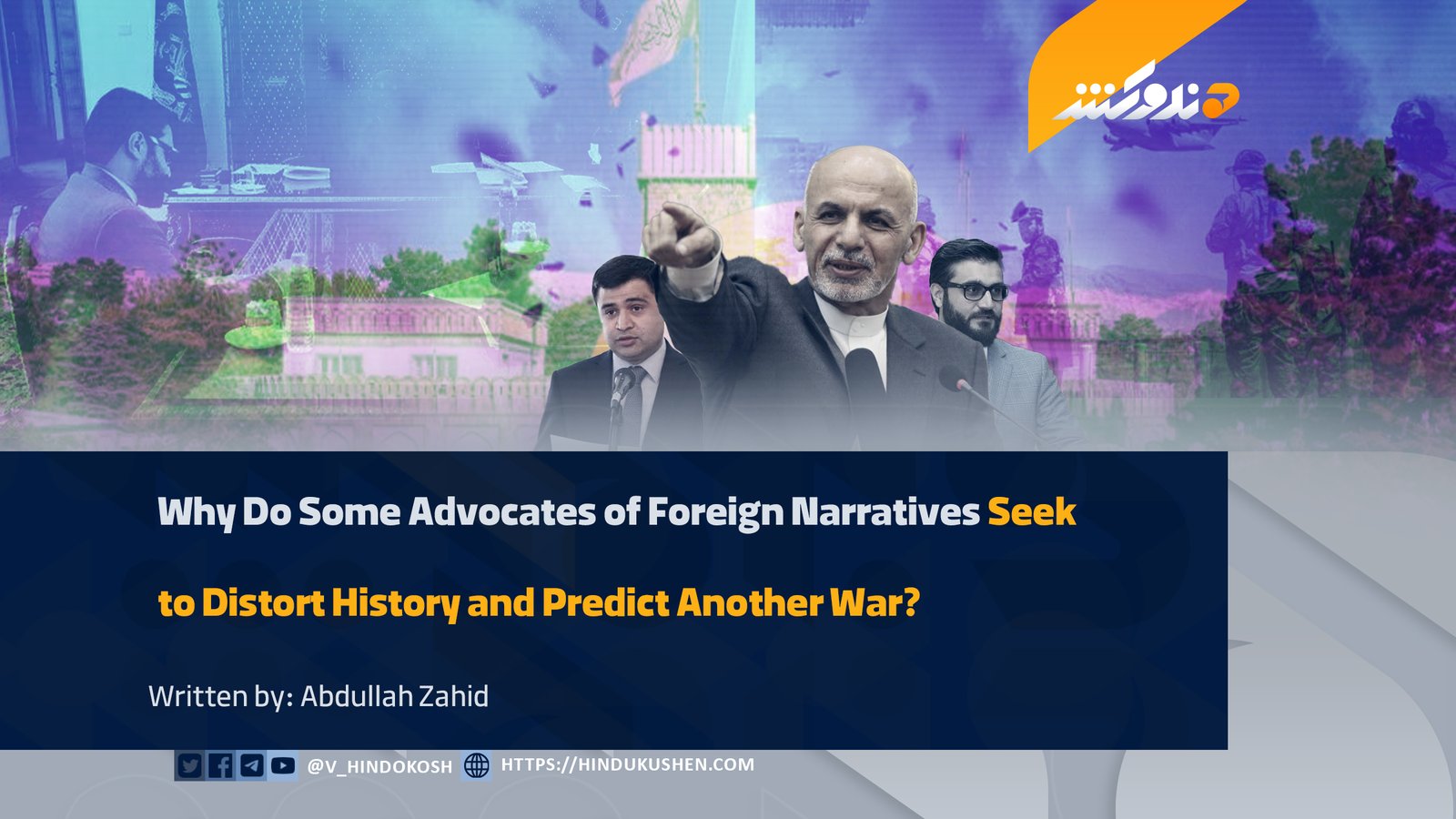
Written by: Abdullah Zahid
One of the great tragedies of Afghanistan’s contemporary history is that some of those who themselves placed the burden of failed policies and occupation on the shoulders of the people are now sitting on the judgment seat of history. Fazal Fazli, who was one of the decision-makers and part of the corrupt triangle (Ghani, Mohib, and Fazli) of the Republic regime in its final years, has once again attempted in his recent statements to encapsulate Afghanistan’s complex history of several decades into a few political slogans and electoral narratives.
Fazli presents a picture suggesting that the changes of 1992 and 2021 were solely victories for Pakistan, and Afghans were merely pawns in others’ games. Such statements not only disrespect Afghanistan’s sacred history but also attempt to cover up the failures for which their ruling circles during the Republic and Western occupation are responsible. The truth is that individuals like Fazli, who today accuse others of slavery, were themselves representatives of foreign occupation and executors of foreign agendas. In essence, the mark of slavery has been stamped on their foreheads like a seal before anyone else.
The stance of Fazli and his political allies is essentially an attempt to belittle and defame the historical struggles of the Afghan people. They today make statements suggesting that the jihad against the Soviet invasion and the sacred struggle against the 20-year American occupation were not the choice and sacrifice of the Afghans, but rather projects of other countries. This is the logic that devalues the blood, sacrifices, and long struggle for independence of millions of Afghans. Afghans have resisted the Soviet Union and stood firm against the Western invasion led by the United States; however, the political circles that have exercised fake power under the shadow of foreign and Western invasions for twenty years are now trying to take the historical victories of the Afghan people away from them and attribute them to foreigners.
Fazli and several other former officials, in justifying their political defeat and failure, want to obscure their narrative of subjugation by attributing every change that occurred after their rule to the influence of Pakistan and the rest of the world. Such analyzes not only distort Afghanistan’s contemporary history but also undermine the value of these historical struggles.
But the most important question is why Fazal Fazli and his companions overlook their role during the judgment of history? If, according to their claim, Pakistan was so powerful that it led the 1992 transformation and also brought about the 2021 change, then what was the outcome of their twenty-year rule, hundreds of billions of dollars, extensive security and intelligence structures, and thousands of foreign advisors? The truth is that behind the fall of the previous republic, more than any foreign factor, the corruption, monopoly, internal rivalries, indifference to the people’s demands, and the loss of public trust of the ruling circle were at play.
A regime like the Republic, whose leaders rely on foreign embassies instead of the people, prioritize the monopoly of power over national unity, and pursue personal and collective interests instead of accountability, it is clear that they are sowing the seeds of their own downfall. Therefore, attributing this great victory of contemporary Afghan history to others does not change the reality, but rather exposes the political anxiety of those who came on Western tanks but fled the country on Western planes; those who now want to downplay the victory and struggle of the Afghans from the same place. They are the same fake rulers of the twenty-year invasion and the collapsed regime who are still not ready to account for their actions and are fleeing.
Behind Fazli and his political allies’ statements, there is another important aspect: the current situation in Afghanistan, which is one of overall security, independence, and development, with all major and minor decisions being made by Afghans themselves, and the people being happy and prosperous; this is unacceptable for the former corrupt ruling class. Those who have weighed their political influence for years under the shadow of foreign invasion, Western support, and international relations are now faced with a reality in which their former influence, privileges, and political centrality have vanished. Therefore, every positive change or sign of stability in Afghanistan is either ignored in their narrative or viewed with suspicion and skepticism; because accepting such a reality would mean the falsification of their past political claims and calculations.
This is the reason, where Fazli’s warning about the “second undeclared war” raises the main question. Why are those who witnessed twenty years of wars, insecurity, and political crises now using the language of war again? Such statements are largely a failed attempt to create political pressure, rally their supporters, and instill a sense of fear about the future. When a politician resorts to predicting war, crisis, and catastrophe instead of reasoning and accountability, it is natural to question whether they are analyzing realities or creating a mental space for a specific political agenda.
The constant mention of the possibility of war is neither in line with the current peace of the Afghans nor with the needs of the nation; rather, it is a perspective that wants to see Afghanistan always thru the lens of crisis. They want to once again take on the project of spilling Afghan blood, sell Afghan land once more, and pave the way for killings. They want to bring war back to Afghanistan so that they can be given fake power and play foreign games with the heads of Afghans, because there is no place in a peaceful and stable Afghanistan to justify their past failed policies, and they will bury this desire this time. The people no longer want war, they no longer want foreign intelligence wars on their soil, and they will no longer be deceived by the baseless claims and misleading political slogans of the opponents.
The struggle for the freedom and survival of Afghanistan is a sacred honor of the Afghan people, not a political commodity for those who today repeat the narratives favored by foreign powers or seek to instill a climate of fear among the people. Fazal Fazli’s recent claims are an insult to historical sacrifices and an attempt to cover up his political failure. History will not judge based on slogans, but rather on truth, sacrifice, and popular stance, that the Afghans have won their struggles with pure faith, determination, and pride in their limited resources.
Note: The articles, essays, and comments published by the Voice of Hindukush only reflect the views of the authors & writers and do not necessarily represent the agreement of the Voice of Hindukush.