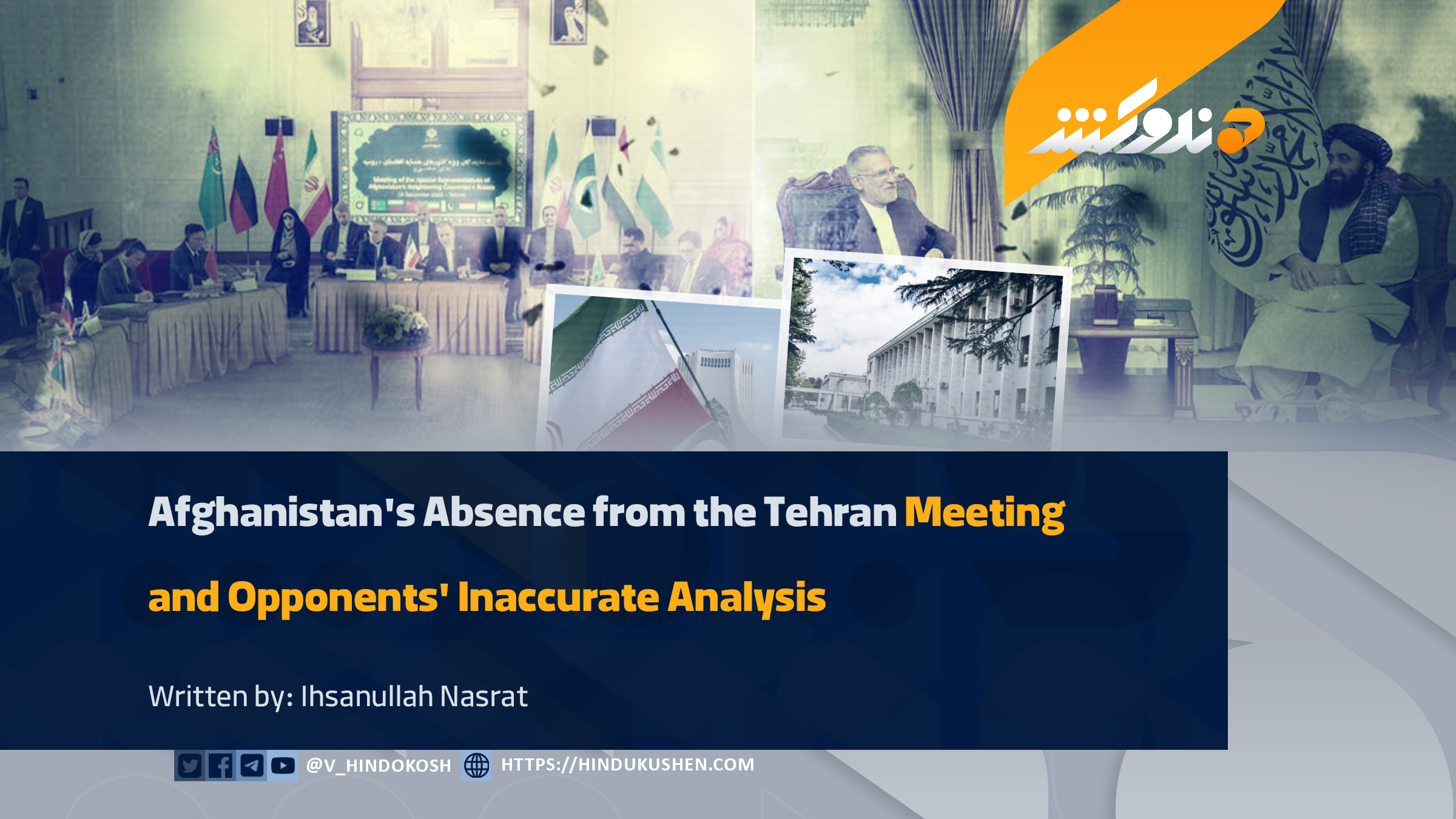
After the meeting of representatives from Afghanistan’s neighboring countries was held in Tehran, and the Afghan government consciously chose not to participate, political opponents quickly and noisily entered the field of analysis and interpretation. These movements, as usual, used media manipulation to try and convey the impression that the absence of the Afghan government from this gathering was a sign of diplomatic weakness, political confusion, and the country’s descent into political isolation.
They also claim that the Afghan government’s non-participation in the neighboring countries’ meeting would exacerbate the migration crises, insecurity, the impasse in international interactions, and the joint pressure from neighboring countries on Afghanistan; analyzes that, rather than being based on field realities, reflect the impure nature, hidden complexes, and inner hatred of the defeated who have not yet been able to come to terms with the new realities of Afghanistan.
By repeating stereotypical narratives and analyzes detached from the reality on the ground, opponents are attempting to sow doubt in public opinion regarding Afghanistan’s political standing and undermine the legitimacy of the government’s independent decisions thru targeted blackening.
This is while the spokesperson for the Afghan Ministry of Foreign Affairs, Hafiz Takal, from the very beginning, stated the government’s clear and explicit stance in an official statement. He stated that Afghanistan does not reject the principle of regional dialogs, but does not consider participating in meetings held without prior coordination, without Afghanistan’s direct presence, and without the agenda being set by the Afghan government to be in the national interest. This stance is a decisive response to the claim of “political isolation” and a sign of diplomacy based on dignity, independence, and national sovereignty.
Zakir Jalali, the head of the third political directorate of the Ministry of Foreign Affairs, also emphasized with an analytical and realistic perspective that linking non-attendance at a specific meeting to “political isolation” is a superficial, simplistic, and illogical interpretation of diplomacy. According to him, Afghanistan is in continuous interaction with regional countries at both bilateral and multilateral levels, and not participating in a specific meeting is not a sign of passivity, but rather reflects Kabul’s independent, selective, and calculated approach to regional diplomacy.
A review of the Iranian Foreign Minister’s positions during the Tehran meeting and the official statement from the country’s Foreign Ministry after the meeting also shows that the purpose of this gathering was not to exert political pressure on the Afghan government. These positions emphasize the exchange of views, understanding the field realities of Afghanistan, and the necessity of regional interaction, which effectively disproves and nullifies the opposition’s claim of a regional consensus forming against Kabul.
The reality is that the Afghan government today considers itself an independent, powerful, and sovereign country, and by not participating in this meeting, it sent a clear message to the world and regional countries: no country has the right to hold a meeting and make decisions about Afghanistan without the prior consent of the Afghan government and without the topics of discussion being determined by it. Afghanistan is a country with independence and sovereignty, and any meeting about this country without prior coordination with its government is rejected and unacceptable.
Countries must respect Afghanistan’s sovereignty and not allow themselves to make decisions on its behalf, as any dialog about Afghanistan without the direct involvement of the country’s government will be lifeless, discredited, and unproductive.
Note: The articles, essays, and comments published by the Voice of Hindukush only reflect the views of the authors & writers and do not necessarily represent the agreement of the Voice of Hindukush.