




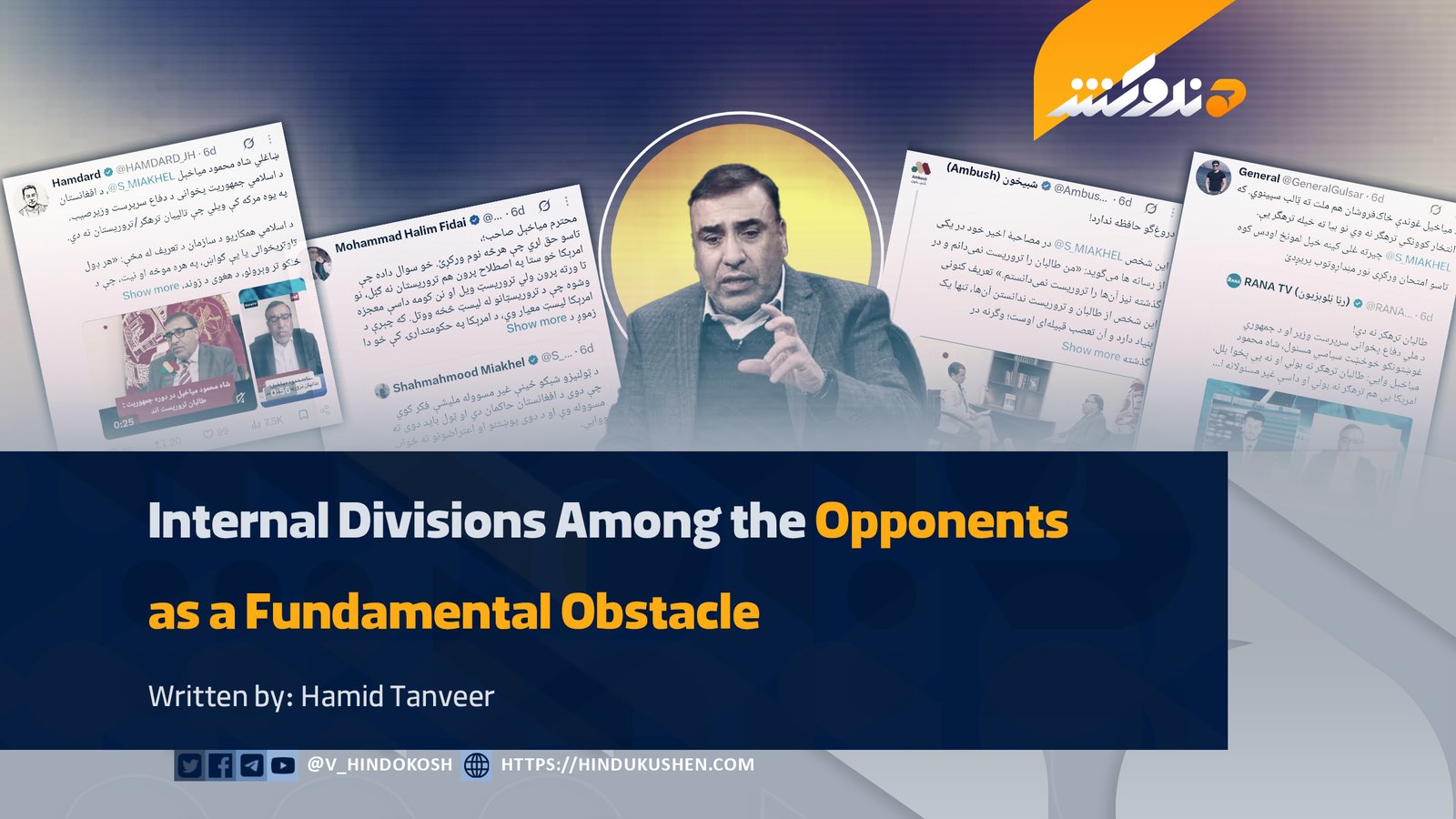
Written by: Hamid Tanveer
The contentious and divisive situation among the Afghan government’s opponents is the fundamental problem that has undermined their political effectiveness. The lack of mutual acceptance among the opposition, the low level of flexibility, and major conflicts over minor and secondary issues are significant obstacles to their coalition and unity.
The biggest gap among the Afghan government’s opponents is the lack of a spirit of acceptance; they acknowledge this gap, and it is evident to everyone. In the past, historical experiences, personal and organizational preferences, and the monopoly of power have led each group to consider itself right and others completely wrong. Now, the intellectual and psychological state of the opponents has been such that they deny everything and only put themselves forward, which prevents the emergence of any kind of mutual understanding.
Another reason for the lack of understanding or flexibility among the opponents is the absence of common interests. The opponents each have their own interests, play for different factions, their opposition is neither a common goal nor are their ideals the same, their paths are not sacred, and they do not have political commonalities that would bring them to accept and understand each other. Each opponent is trying to have only their own opinion accepted and imposed on everyone.
Whenever the issue of understanding and unity arises among the opponents, they get caught up in small and personal matters instead of focusing on major strategic goals. Often, in the meetings of the opposition that are ostensibly held in the name of consensus, intense conflicts and disagreements arise over leadership positions, the texts of declarations, or issues of appearance and form, which can undermine the foundations of large groups and pave the way for fragmentation. Most of the minor disagreements among the opponents indicate that the priorities of their leadership are largely subjective and exclusive rather than aligned with the declared goals.
In an environment where the atmosphere of trust is low and minor disagreements are magnified, the formation of stable and genuine groups/alliances becomes not just difficult, but impossible. If we assume that an alliance is formed in appearance due to external pressures, it will soon disappear during the first small test. Opponents form alliances through declarations, while alliances are built on shared trust, clear strategies, and a spirit of sacrifice, which fortunately, the opponents lack.
The Afghan people were in search of an effective and committed administration that could understand their pains and provide a clear path for a stable future, which they see in the current Afghan government; moreover, when people witness the endless disputes among opposing factions, they completely lose trust in them. Those politicians who lack the ability to unite and tolerate each other naturally cannot gain the trust and support of a living nation.
It is very unlikely that the opposition will challenge the Afghan government through political or military opposition, because the opposing factions are not united among themselves, they quarrel over minor issues, and they cannot exert any serious or effective pressure on the government, nor do they have the capacity to hold it accountable. These are the very things that keep the people safe from their malice, allowing them to live confidently under the shadow of peace, stability, and unity.
Note: The articles, essays, and comments published by the Voice of Hindukush only reflect the views of the authors & writers and do not necessarily represent the agreement of the Voice of Hindukush.