




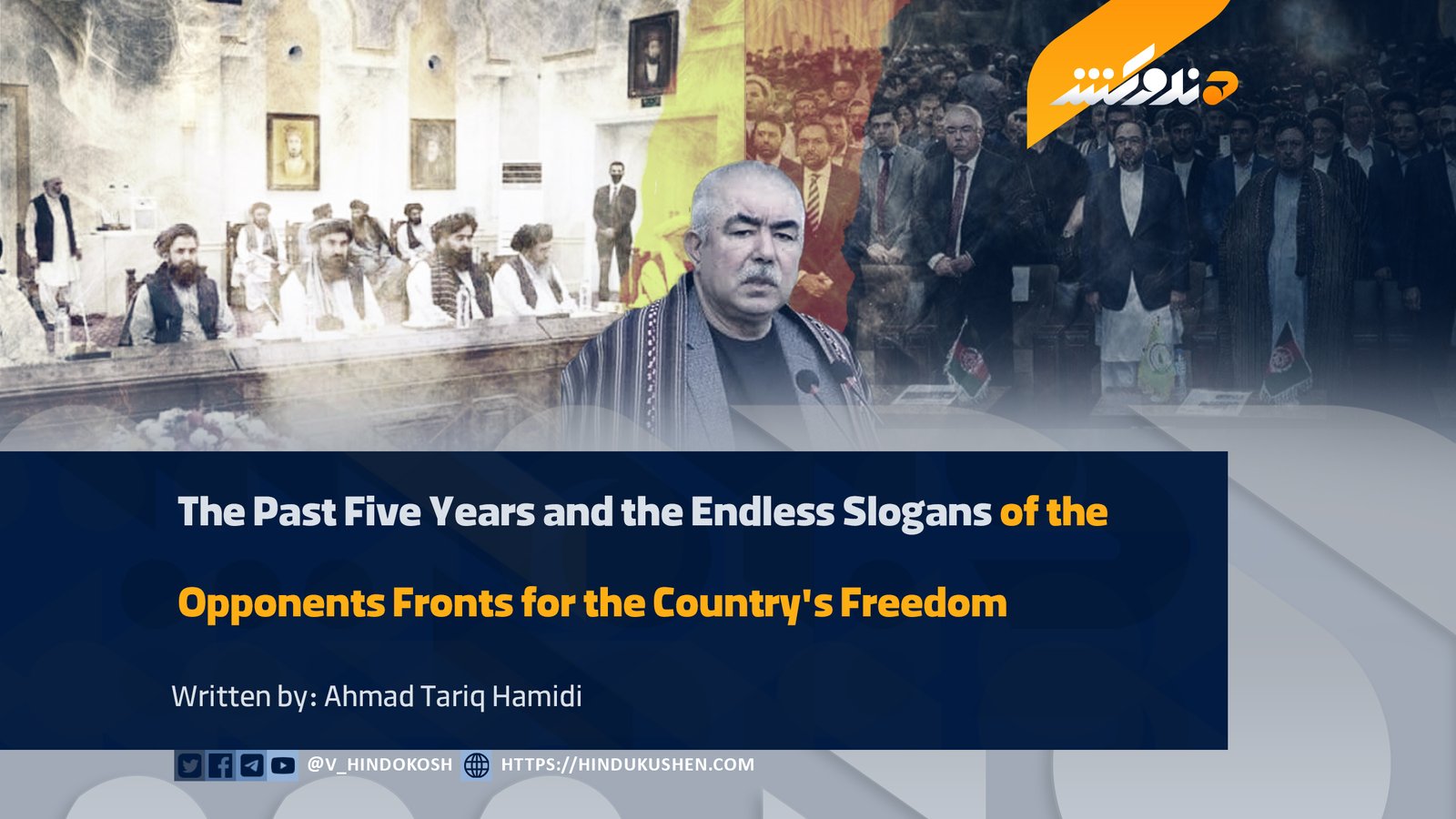
Written by: Ahmad Tariq Hamidi
Almost five years have passed since the fall of the republic and the flight of its leaders; however, it seems that time has stopped for Ahmad Massoud, Sami Sadat, and other opponents figures. They still repeat the same old words, the same usual promises, and the same slogan of “Freedom for Afghanistan”; as if nothing has happened in these five years and the people have forgotten their past and record.
These days, Ahmad Massoud and Sami Sadat have once again announced with great fanfare that they will continue their struggle until the “freedom(!) of the country” and consider this the only possible way. But if we look at their nearly five-year track record, we see that they have gained nothing but the repetition of the same meaningless and tiresome slogans, which might serve as a glimmer of hope and a means for them to obtain money. They have neither taken control of any region, nor achieved any military or political victory, nor created any tangible change in their favor.
For nearly five years, they not only failed to secure even an inch of Afghan soil as their permanent base, but they also became increasingly isolated from the political and international scene. Despite repeated travels, staged meetings, extensive lobbying, and hoping for foreign support, they neither found a reliable ally nor managed to present themselves as a real alternative. What remains are just a few press conferences, a few repetitive interviews, and a multitude of promises that have never been realized.
The reality is that a large part of the leaders of these fronts were themselves pillars of the Republic; a system that, due to widespread corruption, dependency, internal conflicts, mismanagement, and repeated failures, had driven the people of Afghanistan to despair and ultimately collapsed at an unimaginable speed. Many of these figures had been present at the highest levels of power for years; some were commanders, some were ministers, some were advisors, and some played decisive roles in security and political structures. If they truly believe they are chanting for Afghanistan, why, at the time when they had all the resources, billions in budgets, foreign support, and official power, were they unable to save the country from the crises of moral and economic corruption, looting, and incompetence? Aren’t they the very cause of all those problems?
Yes, the record of that period has not yet faded from people’s minds; the years when corruption had become an administrative culture, when power struggles had replaced serving the people, when personal and group interests were prioritized over national interests, when insecurity was spreading, when the economy was in crisis, and when each faction, more concerned with maintaining its own share and position than with the future of the country.
Now, these same individuals, without accepting responsibility for their past or being accountable for their actions, stand again in the position of accusers and are prescribing the solution for Afghanistan’s salvation. But the people ask themselves, what good memories have these figures left in terms of serving the homeland, fighting corruption, ensuring security, strengthening the economy, or defending the people’s interests that they expect to be trusted again today?
Political credibility is not built with slogans; it is built with a track record, and their track record carries more unanswered questions and criticisms than it does capital for gaining trust.
Today, the bitter reality for this movement is that slogans cannot replace action. With slogans, one cannot gain popular legitimacy, with slogans, one cannot conquer geography, with slogans, one cannot change political equations, and with slogans, one cannot restore the lost trust of the people. Repeating a claim, even if done loudly and thru various media, and relying on the darkness of others, will never turn it into truth.
If, after five years, the result of all these claims is only a few statements, a few promotional videos, and a few repetitive interviews, it can no longer be called a “struggle”; rather, it should be considered the continuation of a failed project with new packaging. The people of Afghanistan today distinguish more than ever between slogans and actions, claims and records, and propaganda and reality. As long as this movement cannot provide a clear answer for its past, new slogans will be nothing more than a repetition of the same unfulfilled promises.
Note: The articles, essays, and comments published by the Voice of Hindukush only reflect the views of the authors & writers and do not necessarily represent the agreement of the Voice of Hindukush.