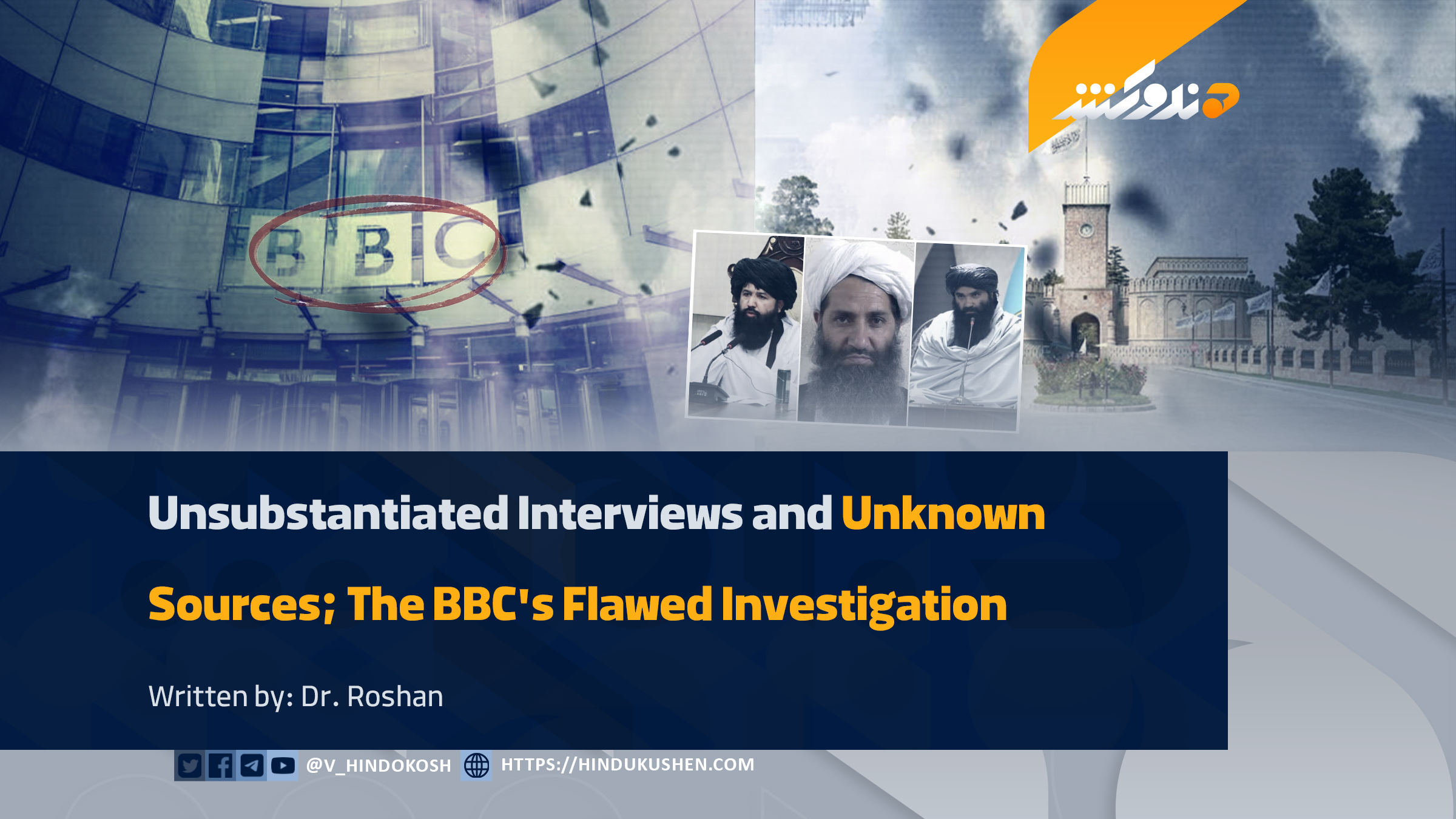
The claim of disagreements among the leadership and leaders of the Islamic Emirate of Afghanistan, published on the BBC news website, states: “In the voice that reached the BBC, the words of Sheikh Hibattullah Akhundzada can be heard saying that internal disagreements could bring them all down.” According to the BBC report, this speech led to an investigation report for this reason.
This report, published in 21 pages, is filled with claims of disagreements within the leadership of the Islamic Emirate, stating that “more than 100 interviews were conducted with current and former members of the Taliban, local sources, experts, and former diplomats in this investigation.” This report was prepared by the BBC Afghan service, whose staff are mostly Afghans and who occasionally visit Afghanistan.
The BBC claims that “for the first time, we were able to identify and speak with two separate groups within the Taliban leadership, each with a distinct and contradictory vision for Afghanistan’s future.” This BBC claim is as false as their previous ones. They have reported on disagreements before but have not provided accurate and verifiable evidence.
So far, no senior official of Islamic Emirate has spoken of disobedience or rebellion. If any place indirectly expresses a difference of opinion, taking the disagreement from it is a meaningless and unfair judgment.
The most surprising claim in the BBC report regarding leadership is that he was considered power-hungry and a seeker of authority; this claim is linked to a time when access to the leadership, Sheikh Hibatullah Akhundzada, was impossible, and furthermore, there was no example of any difference of opinion even before the developments.
But they still in their investigation (?) the baseless, “he said, I said,” narratives of the early days of leadership have been brought. The BBC, in its year-long investigation, has gathered all narratives from anonymous sources. “According to someone, a former member of the Taliban group told the BBC: Sheik Hibatullah Akhundzada has been trying to build his strong group from the very beginning.” Although he initially didn’t have the opportunity to do this, once he gained power, he skillfully expanded his circle and used his position and authority for this purpose.
In this report, they described the so-called Kabul-based group, which is assumed to be the ministers based in Kabul, as being so liberal that they are as freedom-loving as the Emirates and Qatar But no member of the Islamic Emirate would have liked the freedom of women as much as the current Arabs, nor American slavery.
We see that from every stance in Afghanistan, today’s Arabs are criticized and mocked for their “calm but irresponsible” lives. BBC told: “The Kabul group wants an Afghanistan that resembles the Arabs countries.”
The BBC, without mentioning the name of an analyst, described the Kabul-based ministers as incompetent and forced. However, each minister is almost competent in their responsibility, and no one has openly complained. The internet issue is also an example, which was resolved by the Minister of Communications and the cabinet.
The BBC wrote, “According to one analyst, the Kabul group preferred to send a message to both the international community and Afghans, a message that means: we are aware of your complaints and concerns, but what can we do? If the ministers and their so-called Kabul group are incompetent, then how did they reactivate the internet under their control again?
Since the Taliban have internal disagreements and their Amir is also power-hungry, why didn’t the Taliban collapse over the reopening of the internet? Why didn’t the cries of opposition get media coverage?
The BBC has finally linked the issue of education, which is a cultural and religious matter, to the personal interests of the ministers; they said that there were no personal interests of the ministers, but the internet was reopened because it harmed personal interests. That’s not the case; rather, the internet and education are two separate topics, and the mechanisms for addressing both are different. What personal benefits are there? In this rare research published under the auspices of a reputable media outlet, no examples were provided of what personal interests!?
In this report, the BBC quotes UN observers as saying, “The internet shutdown threatened their privileges in a way that was never threatened by the ban on girls’ education.” The Minister of Interior, regarding the Khost talks, which he presented to the younger generation and officials in the form of recommendations, with the clear meaning being an expression of the Emirate’s policy and the leadership’s view, stated that the younger generation of Mujahideen and government officials should avoid violence and show leniency toward the people. The BBC distorted the news and wrote that the Minister of Interior Affairs considers the leadership position to be a hardline stance, which is actually the opposite of the truth.
Also, in those days, the Minister of Higher Education, raised another separate issue, addressing the Mujahideen who were going abroad and intended to go outside Afghanistan with the intention of jihad, recommending that they should obey the Amir.
The BBC has cited the Minister of Higher Education’s remarks against the Minister of Interior without providing evidence, even tho activities of social media clarified in those days that these were two separate issues and that the messages from both were aimed at valuing unity.
Overall, the BBC has blurred the lines between disagreement and opposition, as well as between cracks, with evidence and arguments being non-existent and claims based on rumors, which is not appropriate for a major media outlet and is in clear and shameful conflict with journalistic principles. For a major media outlet, this report is acceptable at the level of personal and biased analysis, but it is not acceptable to readers as a definitive documentary investigation.
Note: The articles, essays, and comments published in Hindukush Voice only reflect the views of the authors, and do not necessarily represent the agreement of Hindukush Voice.