




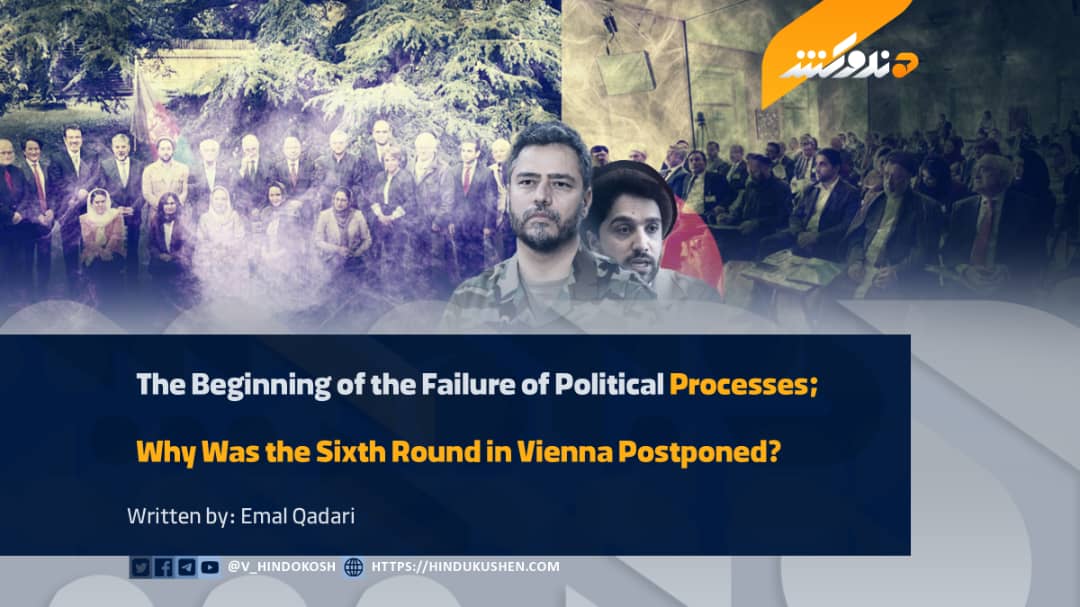
The Vienna Process has announced the postponement of its sixth meeting thru a statement; the reason for the postponement has been cited as recent events, the complex and sensitive situation in the region, and its impact on the political atmosphere. The organizers of the Vienna Process emphasized that the sixth session of Vienna will be held at an appropriate time and in accordance with regional events.
In colloquial terms, in the business and market system, each product has its own selling season, meaning summer goods are not bought in winter, and winter goods are not usable in summer. They have realized that in the current circumstances, no one in the political market would buy them even for two rupees. They call the Vienna process a political gathering, but without any shame, they mention the unfavorable conditions of their sale as reasons for the delay; this delay also highlighted the complete foreign dependence of the opponents.
If the opponents were strong, there would be no need for meetings. The meaning of this is that those groups and individuals who consider themselves opponents and alternatives to the current government, if they truly had political influence, popular support, organized structures, or effective field capacity, they would not have needed to hold successive foreign conferences and issue statements. Strong movements generally establish their presence not by holding meetings in European cities, but thru organized structures, clear programs, and practical impact among the people. Based on this, the Vienna meetings are not seen as a sign of strength by the people, but rather as an example of weakness and the absence of real influence.
These meetings in the past five phases have shown their objectives in this way; they said they would create an alternative political framework for Afghanistan, gather opposing factions, and gain international support. But after the five phases, not only was there no practical change, but the sixth phase, which was supposed to be held in May 2026, was postponed. But the main factors behind this delay are not the points written in the statement, but rather deep political, organizational, and credibility crises.
Another major reason for the delay for such meetings is the negative history of the warlords. The Afghan people remember the civil wars, corruption, monopolies, ethnic dealings, and failed coalitions, which is why these warlords do not receive a warm welcome. In the recent meetings in Vienna, there is a significant presence of those same old faces, which have further diminished the people’s trust. The fact that the same old faces gather for new business every time and everyplace has weakened and diminished the social foundation of this process due to historical distrust.
The monopolistic structure and internal distrust of each meeting by the opponents, where most participants of the initial meetings were not present in the later forming meetings and only one or two groups took their place, have put the Vienna process in crisis. Currently, only a few warlords and intelligence agents from some countries are participants in the Vienna process, who lose credibility among the Afghan people every day.
During the fifth round of Vienna, Ahmad Massoud and Yasin Zia appeared together for the first time, which was considered a high point of the meeting. But the problem was that the actual weight of these fronts was much less than the propaganda suggested, and even due to some minor issues, their differences intensified. In the fifth round of Vienna, there were grand claims, promises were made, and boasting occurred, but so far, it has neither changed the internal power dynamics nor established an organized political structure.
The claim of international support during the Vienna and other processes was not practical, but rather verbal; during these meetings, there was always mention of support from the U.S. Congress, European addresses, and some Western institutions, and they published the encouraging stances of limited foreign circles on their official accounts. They wanted to attract public support thru propaganda, but later all of this proved to be false and imaginary.
The announcement of the suspension of the Vienna process may be the announcement of the permanent end of this process. Opponents will try to present the delay of the sixth phase as a technical decision, but in such foreign political processes, sometimes a delay is a sign of gradual disappearance. The Vienna process has also reached such a stage.
Note: The articles, essays, and comments published by the Voice of Hindukush only reflect the views of the authors & writers and do not necessarily represent the agreement of the Voice of Hindukush.