




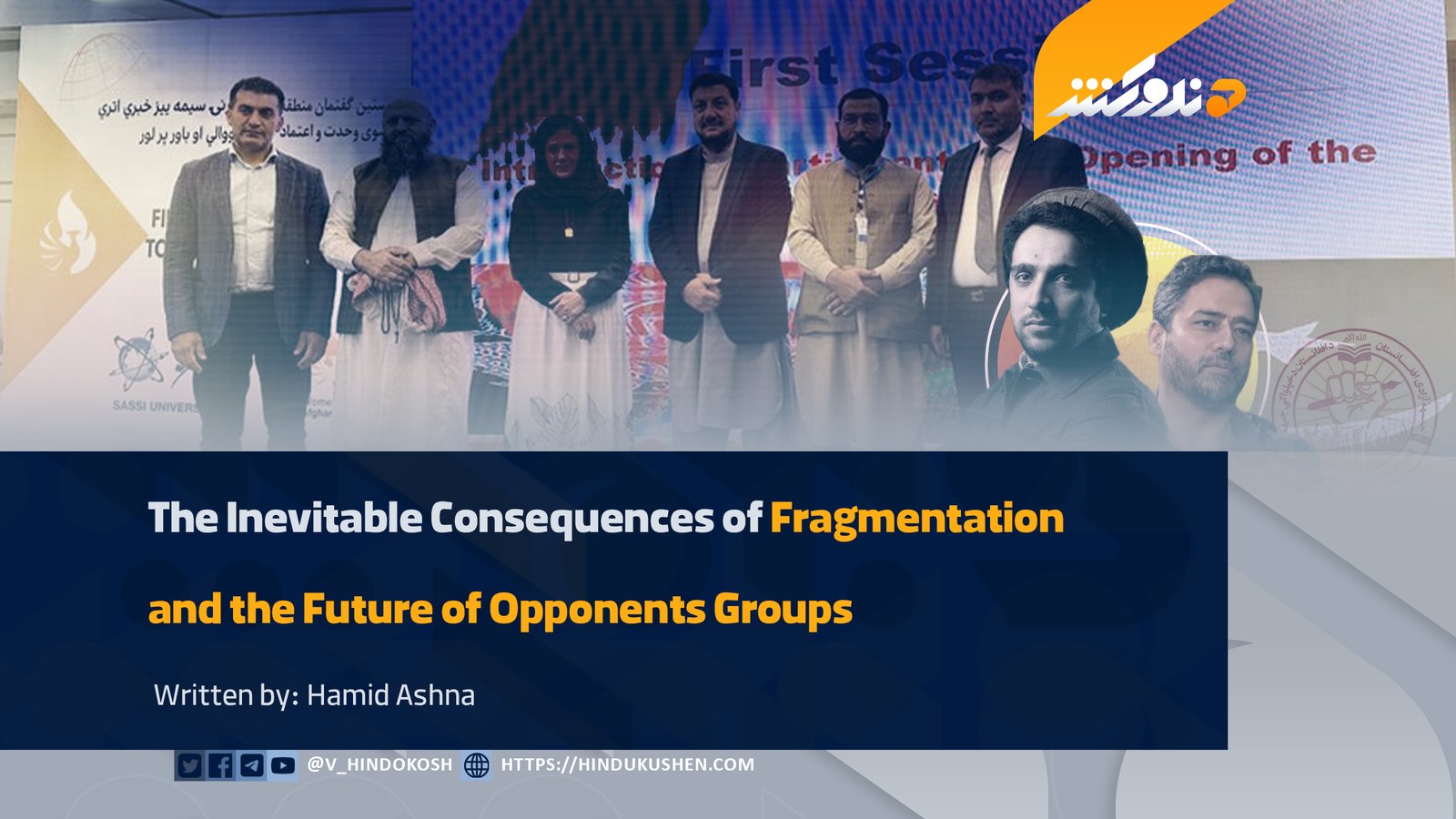
Written by: Hamid Ashna
The daily fragmentations and separations within the opposing groups have become a sign of a deep intellectual, organizational, and political weakness. Whenever minor disagreements arise among a few individuals within the ranks of opposing groups, they immediately declare a new front. This indicates that the opponents prioritize personal desires over strategic thinking. After the formation of successive new fronts, only the thoughts of two or a few limited individuals are given space there, and they are only pleased with long imaginary names.
Priority is given to the proliferation of names and organizations among the opposition, while the multitude of groups is a clear indication of their fallen and fragmented state. We see the main causes of these splits in unhealthy rivalries among the opposition leaders, issues over the distribution of power and privileges, and the lack of a unified mindset. Whenever the spirit of shared principles and sacrifice weakens in such lines and individual leadership prevails over collective decision-making, even the smallest disagreement becomes a pretext for separation. In such an environment, there is no room for patience and tolerance for great goals, and everyone tries to create a separate framework according to their own preferences.
Logically speaking, considering these continuous divisions and separations, the question arises whether these divisions can lead the opponents to their goals or not! Every major goal requires organized coordination, centralized resource allocation, and united will, but when a group is divided into dozens of smaller factions, its resources are dispersed, and its political and practical effectiveness is weakened. Therefore, the emergence of countless small groups eliminates the chance of reaching the goal and places them at an even greater distance.
Similarly, the concern that continuous divisions will make the opponents even more aimless and directionless is not unfounded. When the motivation for forming alliances is short-term grievances or personal differences instead of a clear and long-term strategy, the presence of vision and purpose naturally diminishes. Over time, the grand objective also diminishes, and rivalries, mutual accusations, and efforts for organizational survival replace the original purpose.
On the other hand, another logical consequence of the splits is the weakening of public trust and support, which we are now practically witnessing regarding the opponents. Even the supporters of these isolated opponents usually believe in movements that have stability, order, and a clear path, but when they hear news of new names and splintered groups every day, their sense of distrust grows stronger. Thus, the process of further fragmentation among the opposition has internally undermined their cohesion and rendered them ineffective.
Note: The articles, essays, and comments published by the Voice of Hindukush only reflect the views of the authors & writers and do not necessarily represent the agreement of the Voice of Hindukush.